A bag can hold your laptop and still fail before you reach the office. Add a charger, lunch container, umbrella, and sweater, and suddenly the zipper will not close or the straps barely fit over your coat.
The right fall work bag should pass three tests: your laptop fits securely, your everyday items fit without crowding it, and the packed bag feels comfortable to carry. Start with measurements and a realistic packing list. Choose the color after those basics work.
Measure the laptop, including its case
Before shopping for a fall work bag, measure your closed laptop’s width, depth, and thickness. If you use a protective sleeve or hard case, measure it with that protection on.
A laptop’s advertised screen size describes its diagonal screen measurement, not the dimensions of its outer shell. Two computers sold under the same screen-size label can therefore need different amounts of space.
Compare your measurements with the bag’s usable laptop compartment, rather than its exterior dimensions. Padding, seams, and tapered sides all take up room. Also check the opening: a roomy interior is little help if the computer catches on a narrow zipper.
If the seller provides only “fits most 15-inch laptops,” ask for internal measurements or confirmation for your specific model. Avoid buying a tight fit on the assumption that the material will stretch.
Check what “laptop compartment” actually means
A divider keeps a computer separate from other belongings, but it is not necessarily padded. For example, Timbuk2’s Classic Messenger product page explicitly states that its internal divider pocket is unpadded. That distinction matters when comparing bags advertised as laptop-compatible. Lifetime Warranty
For a fall work bag carrying your computer daily, look for padding around the device, especially underneath it. A raised sleeve that stops above the bag’s base can provide separation from the floor when you set the bag down, though it is not a guarantee against impact damage.
Check whether a strap or closure holds the computer in place. If you prefer a tote without built-in padding, allow room for a separate protective sleeve and include its weight in your comparison.
Pack for an ordinary workday
Lay out everything you normally take to work before deciding how much space you need. Include the objects that are easy to forget during shopping:
- Laptop, charger, and any necessary adapters.
- Phone, wallet, keys, and work badge.
- Notebook, headphones, and personal-care pouch.
- Filled water bottle and packed lunch.
- Compact umbrella and the layer you remove indoors.
Your fall work bag needs usable space around the computer, not just enough width to accommodate it. A lunch container needs depth; a sweater needs flexible space; a bottle needs a pocket that fits its actual diameter.
Capacity in liters can help compare bags, but it cannot confirm laptop fit or a useful layout. A tall, narrow bag and a wide, shallow tote can organize the same volume very differently.
Avoid choosing extra capacity solely for things you carry twice a year. For occasional gym gear or a large lunch, a separate washable bag may suit your routine better.
Match the carrying style to your commute
The best fall work bag for a short drive may be a poor choice for a long walk and two train changes. Use your most demanding regular commute as the test.
| Bag style | When it may suit you | What to check |
|---|---|---|
| Laptop tote | Short carries and frequent access to belongings | Handles fit over a coat; loaded bag stays comfortable |
| Backpack | Longer walks, transit transfers, and carrying more gear | Both straps adjust well; laptop stays secure |
| Messenger or crossbody | Hands-free access with a moderate load | Strap does not slip; bag does not swing excessively |
| Briefcase | Laptop, documents, and a compact daily kit | Enough depth for accessories; comfortable handle or strap |
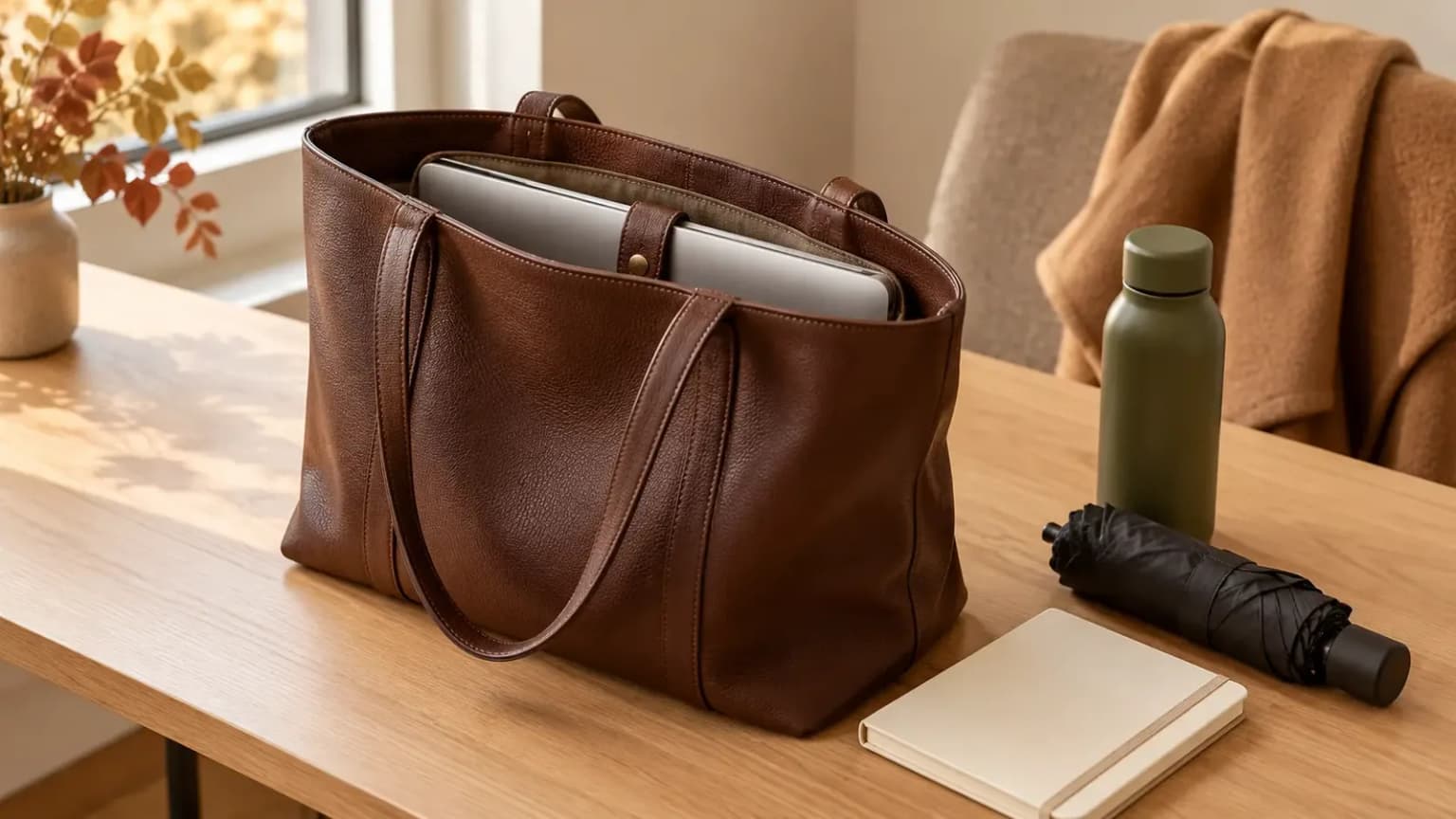
For a laptop tote bag for work, pay particular attention to handle drop: the distance between the top of the bag and the underside of the handle. Try it over your actual jacket. A comfortable summer fit can feel cramped with thicker sleeves.
Convertible designs deserve the same scrutiny. Test each carrying mode rather than assuming extra straps make every configuration comfortable.
Give small essentials a specific home
A fall work bag does not need a pocket for every object. It needs a layout that makes your usual routine easier.
Prioritize a secure place for keys and your badge, a pouch or compartment for charging cables, and a bottle holder that keeps your drink upright. An exterior bottle pocket can separate the container from electronics, but it does not eliminate spill risk.
Check pockets with the main compartment full. Some internal bottle holders take space away from lunch; some front pockets become difficult to use once the laptop is inside.
A light-colored lining can make small items easier to spot. Removable pouches are useful when you switch bags, provided they do not add so much bulk that the zipper strains.
Plan for fall weather without overreading the label
A fall work bag may encounter wet sidewalks, crowded coat racks, and an umbrella that has not dried. Look beyond the fabric description to the closure, seams, and base.
Water-resistant does not automatically mean waterproof. Osprey, for example, distinguishes the limits of water-repellent treatment from the additional protection of a rain cover in wetter conditions. For frequent rain, check the bag maker’s stated protection and consider a properly sized cover. Waterproof Backpack Protection
A zippered top helps contain belongings, but an ordinary zipper alone does not establish waterproofing. Keep a wet umbrella in a separate waterproof pouch or outside pocket.
Read the care instructions before choosing a material. If your routine requires quick wipe-downs, avoid buying a finish whose maintenance you will resent.
Choose colors from your existing clothes
Your fall work bag should coordinate with the coat and shoes you wear most, not require a new wardrobe.
Chocolate brown, burgundy, olive, navy, and black are possible starting points, rather than a mandatory seasonal palette. Compare the actual shade with several regular outfits. Product photos can make similar colors look warmer or cooler than they are.
If you want your fall work bag to work throughout the year, a simple shape and a color already common in your wardrobe may be easier to reuse than a strongly seasonal design.
Treat texture and hardware as finishing decisions. They cannot compensate for uncomfortable handles or an undersized compartment.
Try this packing test before keeping it
Here is a hypothetical example: your sleeved computer measures 14 by 10 by 1 inch, and a fall work bag lists an internal laptop compartment of 14.5 by 10.5 by 1.2 inches.
Those measurements make it worth testing, not an automatic fit. Rounded corners, padding, and the opening can still interfere. Insert the device without forcing it, then pack your normal daily load.
Test your fall work bag indoors while keeping it within the retailer’s return conditions:
- Close every zipper without pressing down on the contents.
- Remove the laptop without unpacking lunch.
- Retrieve your keys and badge without putting everything down.
- Walk for several minutes wearing your usual coat.
- Check for slipping straps, uncomfortable pressure, and awkward swinging.
Check the empty bag’s weight, too. A heavy shell leaves you carrying extra weight before you add a single essential.
Before buying a new fall work bag, run this same test on one you already own. A better sleeve or smaller cable pouch may solve the problem. If it does not, you will have a precise shopping list and a clear reason to reject a bag that only looks right.