
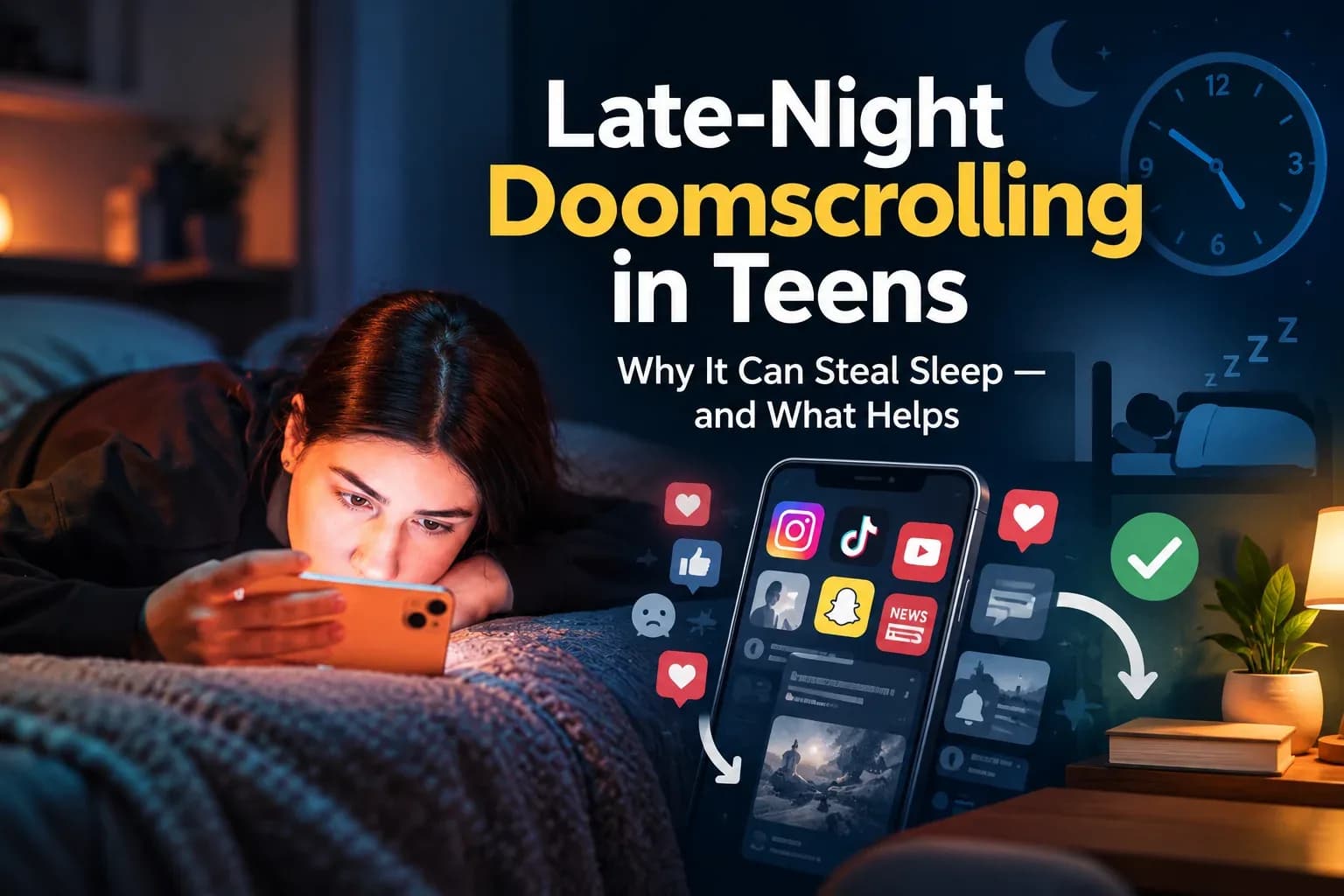
Late-night doomscrolling in teens can push bedtime later, expose young people to upsetting or stimulating content, and make it harder to wind down. A 2026 study using smartphone records found that many adolescents used their phones during school-night hours, often on social media. The study did not measure sleep directly, so it shows a pattern worth addressing not proof that phones alone caused sleep loss. PMC
For families, the useful response is a calmer, shared evening routine rather than a blame-focused battle over screen time. Small changes such as charging phones outside bedrooms and agreeing on a screen-free wind-down can make it easier to protect sleep while respecting teens’ growing independence.
What the 2026 study found about late-night doomscrolling in teens
Researchers analyzed passively recorded Android phone activity from 657 participants in the Adolescent Brain Cognitive Development study. Their JAMA Pediatrics research letter, published online May 18, 2026, examined school nights between 10 p.m. and 6 a.m. The adolescents averaged about 50 minutes of smartphone use in that window; social media made up the largest app category, averaging about 33 minutes. More than half used a phone between midnight and 4 a.m. at least once during the monitoring period. PMC
Those results offer a clearer picture of late-night doomscrolling in teens than asking people to remember every phone check. But the sample was Android users who contributed at least two nights of data, and the research was cross-sectional. It did not record whether the teen was awake, what they were doing within an app, or how much they slept.
That distinction matters when discussing late-night doomscrolling in teens: doomscrolling usually means repeatedly consuming negative or distressing online content. The study measured app use, not doomscrolling itself. Its findings therefore support concern about nighttime smartphone habits, but cannot tell us how many teens were scrolling through distressing news or whether that behavior caused sleep problems.
Why late-night doomscrolling in teens can interfere with sleep
Late-night doomscrolling in teens can interfere with sleep in several ways. It can take time away from sleep, keep the mind engaged with messages or emotionally charged material, and make it harder to stick to a regular bedtime. Notifications can also invite a teen back into a conversation after they have put the phone down.
The American Academy of Pediatrics and the American Academy of Sleep Medicine recommend that teenagers get eight to 10 hours of sleep per night. Sleep supports learning, attention and mood, so repeatedly losing rest can make school mornings and daily routines more difficult. It is more accurate, however, to say that poor sleep and nighttime screen use are concerns than to claim every teen who uses a phone at night will experience a mental health problem.
The phrase social media and teen sleep covers many different activities: messaging friends, watching videos, gaming, reading news or using an app for school. A check-in with a friend is not the same experience as a distressing news feed, and the impact depends on timing, content and whether phone use is displacing sleep.
Why late-night doomscrolling in teens can be hard to stop
Understanding late-night doomscrolling in teens makes the habit easier to discuss. Some teens check their phones because friends may be messaging late, because they fear missing an update, or because scrolling has become a default way to relax. A busy day may leave late evening as their only unstructured time.
Adults can ask what keeps the habit going before imposing a rule. Is the teen worried about missing messages? Are distressing headlines increasing anxiety? Is the phone the only way they can unwind? The answer shapes a more useful plan. Doomscrolling may also be a response to stress, so turning off a device can help with the routine without resolving the underlying concern.
How teens can stop doomscrolling without a nightly fight
To interrupt late-night doomscrolling in teens, families can test realistic phone habits for a week and adjust them together:
- Choose a stopping point. Set a shared time to finish social media, news and games before bed. NHS youth sleep guidance suggests switching off devices about an hour before bedtime and choosing a quiet offline activity instead. cambspborochildrenshealth.nhs.uk
- Move the charger. Charge phones outside the bedroom, or place them across the room with notifications silenced. If the phone is needed for safety or an alarm, agree on an exception that still limits alerts.
- Reduce the feed’s pull. Turn off nonessential notifications, use app time limits or unfollow accounts that repeatedly leave the teen distressed. These tools can create friction, but a teen may need support to maintain the change.
- Replace the routine. Offer appealing alternatives: music, a shower, reading, drawing, journaling or a brief conversation. A rule with no replacement can feel like losing the only way to decompress.
- Keep the conversation open. Ask whether the change is helping sleep and mornings. If it is not, revisit the plan rather than treating it as a test of obedience.
Parents and caregivers can model the same boundary by putting their own phones away during the agreed wind-down. A family rule is easier to accept when adults follow it too. The goal is not to eliminate all technology, but to prevent the feed from taking over time set aside for rest.
When screen use or sleep problems need more support
Nighttime screen time and mental health deserve attention when a young person regularly feels unable to stop, is distressed by what they see, or is losing sleep in a way that affects school or daily life. Start with a calm conversation. Ask about the content, social pressures and sleep pattern without assuming that the phone is the only cause.
If sleep problems persist or anxiety, low mood or daytime exhaustion are affecting everyday life, a family can speak with a pediatrician, general practitioner or qualified mental health professional. Seek urgent local help if a teen may be in immediate danger. General screen advice cannot diagnose the cause of sleep or mental health symptoms.
Late-night doomscrolling in teens is a practical sleep concern, but the evidence should be described carefully. A recent study documented substantial phone activity during school-night hours; it did not establish that doomscrolling caused sleep loss. Families can still respond to late-night doomscrolling in teens by agreeing on a wind-down time, moving phones away from beds and addressing the reasons teens keep checking. A consistent, respectful routine gives sleep a better chance without turning technology into a family-wide argument.