
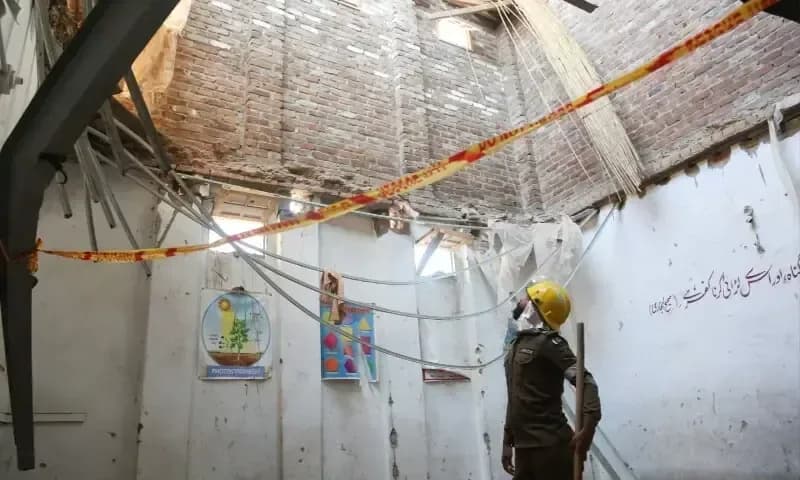
A roof gave way over a classroom full of young children in Peshawar on Thursday morning, October 15, 2026, killing at least 33 people — nearly all of them students between 7 and 14 — and injuring dozens more. The Pakistan school roof collapse has already led to the arrest of the school's owner, and the provincial governor has ordered a safety audit of every school in the province. Here is what has been confirmed, what is still disputed, and why this keeps happening.
What happened
The Pakistan school roof collapse hit the Al-Khair school, a small private school operating out of a three-story residential building in Dir Colony, a congested inner-city neighborhood of Peshawar, the capital of Khyber Pakhtunkhwa province near the Afghan border. Classes had just started. A parent who rushed to the scene told Dawn, Pakistan's largest English-language daily, that he got the call at about 8:50 a.m. local time — roughly midnight on the U.S. East Coast.
A rescue official told AFP that the roof of an upper floor failed first, and the weight brought down the ceiling of the classroom below, pancaking two stories. Police said about 30 children were in upper-floor classrooms at the moment of the Pakistan school roof collapse.
Residents reached the site before emergency crews did. One neighbor told CBS News the street was so narrow that ambulances struggled to get close, and parents were pulling children out by hand. Provincial police set up a "green corridor" to clear ambulance routes, and army personnel joined the search. By mid-afternoon, Peshawar's deputy commissioner said all debris had been cleared and no one remained trapped.
The death toll, and why the numbers differ
If you have seen Pakistan school roof collapse figures ranging from 27 to 35, that is not sloppy reporting — it reflects a toll that rose through the day and bodies taken to more than one hospital.
| Source (as of Thursday afternoon, local time) | Reported deaths |
|---|---|
| Dawn, citing Lady Reading Hospital spokesperson | 33 (32 students, 1 teacher) |
| CNN | 33 (32 children, 1 teacher) |
| AP (via local affiliates) and Express Tribune | 35 (34 children, 1 teacher) |
| Earlier wire reports (NBC, France 24) | 28–30 |
The most conservative confirmed figure is 33, from Lady Reading Hospital, the main trauma center that received most of the casualties. The hospital said the dead students ranged from 7 to 14 years old. Injury counts vary even more: the hospital reported 20 children admitted, most since discharged and three with serious head injuries, while AP and CNN put total injuries across facilities at around 50. The Associated Press described this Pakistan school roof collapse as the deadliest incident of its kind in the country.
Expect a final official count once the provincial inquiry reports. Until then, treat any single number as provisional.
Why the roof came down: what police allege
Peshawar's police chief, Mian Saeed Ahmed, has been blunt about the Pakistan school roof collapse. Speaking to Reuters and AFP, he called it "a weak building structure" and said construction work on top of the roof had overloaded it. CBS News separately reported that a local police official described ongoing construction on the roof as a possible cause.
The Express Tribune reported a further detail from officials: the roof slab was built using thin clay tiles or tapered bricks — a traditional, inexpensive method common in older Pakistani construction — rather than reinforced concrete. In plain terms, that kind of roof is designed to keep rain out, not to carry the weight of another floor being built on top of it.
The owner, identified by police as Mohammad Khan, was arrested within hours. According to the AP, he has blamed this week's rains for weakening the roof. Heavy overnight rainfall was also cited by a rescue official who spoke to CNN. Some local outlets report the school's principal was also detained; that has not been confirmed by major wire services.
What is confirmed: the building was a converted residence, the roof failed during class hours, and the owner is in custody.
What is alleged but not yet established: that unauthorized construction overloaded the roof, that rain contributed to the Pakistan school roof collapse, and whether the school was licensed to operate in that building at all. Police said they are investigating when the school was established.
What is in dispute: how many students the school had. Police told local media about 110 were enrolled. An injured teacher told the AP from her hospital bed that the figure was closer to 1,200. That gap matters for understanding how crowded the building was and should be resolved by the inquiry.
The official response
The reaction to the Pakistan school roof collapse from the country's leadership was fast, in part because the province is currently under federally imposed governor's rule, which puts the governor — rather than an elected provincial government — in direct charge.
- Governor Faisal Karim Kundi ordered a structural safety audit of educational institutions across Khyber Pakhtunkhwa and demanded a detailed report.
- The provincial Elementary and Secondary Education Department formed a fact-finding committee, chaired by the head of the Private Schools Regulatory Authority, with instructions to report the same day.
- Prime Minister Shehbaz Sharif and President Asif Ali Zardari both called for comprehensive investigations, with Zardari specifically urging checks on whether all school buildings meet safety standards.
A same-day deadline for a report on the Pakistan school roof collapse is a signal of political urgency, not necessarily of thoroughness. The more meaningful test is whether the province-wide audit actually happens and whether its findings are made public.
Why this keeps happening
For American readers, the most striking part of this story may be how familiar it is to Pakistanis. Thursday's event is not the first Pakistan school roof collapse of 2026. Dawn's running tally of recent incidents includes a private tutoring center in Lahore where 14 children died on June 30, a classroom roof in Dera Ghazi Khan that killed four children in May, and a school wall near Umerkot that killed three girls in July. Building failures are routinely attributed to substandard materials and weak enforcement of construction codes.
Three structural problems sit underneath the pattern:
- Low-cost private schools fill a gap the state does not. Many families in poorer neighborhoods rely on small, inexpensive private schools because government schools are overcrowded or distant. These schools typically rent whatever space they can afford — often a house never designed for 100 or more children.
- Regulation focuses on paperwork, not buildings. Pakistan's provinces have private-school regulatory bodies, but their oversight has historically centered on registration and fees. Structural inspection is largely the job of separate municipal authorities with limited capacity.
- Incremental, informal construction is normal. Adding a floor to an existing building, without an engineer's assessment, is common practice across South Asia. When the original structure was built with traditional tile-and-brick roofing, the added load can be fatal — which is the leading explanation for the Peshawar Pakistan school roof collapse.
None of this excuses what happened. But it explains why an arrest and an inquiry after each Pakistan school roof collapse have not, on their own, prevented the next one.
What to watch in the coming days
If you want to follow the Pakistan school roof collapse story past the first news cycle, these are the questions that will determine whether it leads to anything:
- Does the fact-finding report get published, and does it name responsible officials as well as the owner?
- Was the school registered with the Private Schools Regulatory Authority, and had the building ever been inspected?
- Does the province-wide audit produce a public list of unsafe school buildings — and are any closed as a result?
- Does the final death toll settle, and do hospital and government figures agree?
- Are charges filed against anyone beyond the owner, including whoever approved or ignored the rooftop construction?
Previous incidents have generated the same promises. The June collapse in Lahore prompted an inquiry and arrests, yet four months later, children in Peshawar were sitting in a classroom beneath an overloaded roof. The measure of the response to this Pakistan school roof collapse will be what is different by the start of the next school year.