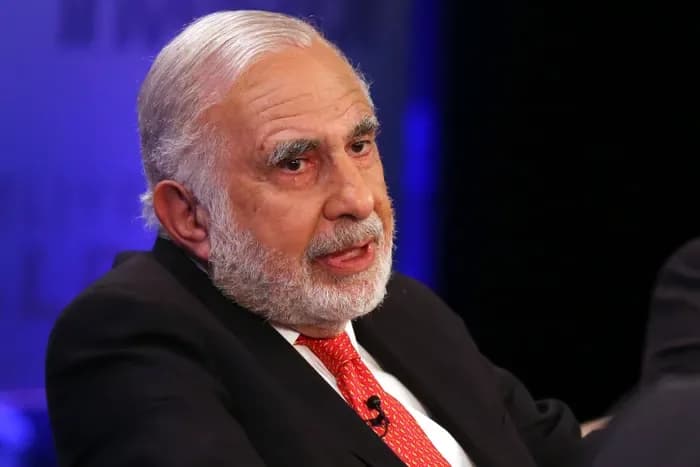
Carl Icahn, the 90-year-old activist investor who defined corporate raiding in the 1980s, is no longer one of the 400 richest Americans. His fortune stood at an estimated $4.2 billion when the 2026 Forbes 400 closed, roughly $200 million short of the cutoff. It ends a streak of 39 consecutive appearances that began in 1987, when Ronald Reagan was in the White House.
The short answer to "what happened" is not one bad year. It is a dozen years of betting against a stock market that kept going up, a short-seller report that cut his holding company's value by 86%, and a loan structure that turned every drop in that company's price into a personal problem.
What does it mean that Carl Icahn is off the Forbes 400?
It means Icahn's estimated net worth fell below the amount needed to rank among the 400 wealthiest people in the United States for the 2026 edition of the list. Thirty-four people from the 2025 ranking dropped off this year, but Icahn's exit stands out because of how long he had been there and how far he fell.
The Forbes 400 has been published every year since 1982. It estimates net worth by adding up a person's known assets, including public stock, private company stakes, real estate and cash, then subtracting debt. For someone like Icahn, whose wealth sits mostly in one publicly traded company, the estimate moves with that company's share price.
Icahn disputes the published estimate. His net worth had already climbed back to nearly $4.5 billion within days of the list's release, which shows how close to the line he sits.
How much money has Carl Icahn lost?
Icahn has lost nearly $22 billion since his fortune peaked at $26 billion in 2014. That is a decline of more than 80% in twelve years, during a period when the broader US stock market roughly quadrupled.
Here is the rough arc of his net worth over four decades:
|
Year |
Estimated net worth |
What was happening |
|
1987 |
$525 million |
Joins the Forbes 400 at age 51 |
|
1994 |
$400 million |
TWA bankruptcy drags him down |
|
2008 |
~$15 billion |
Casino sale, activist fund gains |
|
2014 |
$26 billion |
Peak: Apple, Netflix, Herbalife wins |
|
May 2023 |
$12 billion |
One-day drop after Hindenburg report |
|
Sept 2026 |
$4.2 billion |
Misses the cutoff |
The most striking number is a hypothetical one. If Icahn had sold everything in 2014 and parked $26 billion in an S&P 500 index fund, he would be worth more than $130 billion today before taxes. That would rank him around 10th richest in America, ahead of Bill Gates and Michael Bloomberg.
Why did Carl Icahn's funds keep losing money?
Icahn's funds lost money in seven of the nine years from 2014 through 2022, mainly because of large short positions against the overall stock market. A short position is a bet that prices will fall. When the market rises instead, the short loses money, and Icahn's shorts were enormous.
The losses were especially steep in 2015, 2016, 2019 and 2020. Every one of those years, the S&P 500 finished with a positive total return. Icahn has long described the shorts partly as a hedge to protect his long-term stock holdings and partly as a genuine call that the market was overpriced. Either way, the cost was in the billions.
Bad energy bets added to the damage. And the pattern has not changed in 2026. In the first half of this year, while the S&P 500 gained about 10%, Icahn's investment funds fell 18.2%, Forbes reported. Roughly $1 billion of that came from short positions, including about $523 million on refinery hedges and $292 million on broad-market hedges.
His long positions have struggled too. Four of the funds' five largest disclosed stock holdings at midyear were down for 2026 as of mid-September: Monro by about 40%, Centuri by 23%, EchoStar by 14% and JetBlue by 4%.
What did the Hindenburg Research report say about Icahn Enterprises?
In May 2023, short seller Hindenburg Research published a report arguing that Icahn Enterprises (ticker: IEP), Icahn's publicly traded holding company, was worth far less than its market price. Its main claims:
• IEP units were inflated by at least 75% and traded at a 218% premium to the company's own reported net asset value.
• The company's 15.8% distribution yield could not be sustained on its own earnings.
• Because Icahn took most of his distributions in new units rather than cash, while the company kept selling new units to the public, Hindenburg described the arrangement as "Ponzi-like."
• Icahn had borrowed heavily against his IEP stake, creating margin-call risk for other unitholders.
IEP called the report self-serving and disputed it. But the market reaction was immediate. Icahn's net worth dropped from $18.3 billion to $12 billion in a single day. Since the report, IEP units have fallen 86%, and the company cut its annual distribution from $8 per unit to $2.
For readers unfamiliar with the structure: IEP is a master limited partnership, so it issues "units" instead of shares and pays "distributions" instead of dividends. Icahn owns the large majority of those units, which is why the company's price and his personal wealth move together.
Did the SEC take action against Carl Icahn?
Yes. On August 19, 2024, the Securities and Exchange Commission announced settled charges against both Icahn and IEP for failing to properly disclose that Icahn had pledged his IEP units as collateral for personal margin loans worth billions of dollars.
The SEC found that Icahn had pledged somewhere between 51% and 82% of IEP's outstanding units at various points since at least 2018, and that required disclosures were incomplete for years. IEP agreed to pay a $1.5 million civil penalty and Icahn agreed to pay $500,000. Neither admitted or denied the findings.
The penalty was small next to the losses, but the underlying issue was the same one Hindenburg had raised: Icahn's fortune was leveraged. When you borrow against stock and the stock falls, lenders can demand more collateral or force sales. After the Hindenburg report, Icahn restructured about $3.7 billion in personal loans and removed the link between IEP's market price and his collateral requirements. It is a reminder of how much borrowing costs can shift when interest rates move, whether you run a holding company or a corner store.
Does Icahn's exit say something bigger about how wealth is built now?
Partly. The top of the 2026 list is dominated by technology founders. Even on Wall Street, the biggest fortunes now belong to people like Ken Griffin, Israel Englander and Steve Cohen, who built large, systematic, technology-driven investment firms.
Icahn's model was different. He took big stakes in a handful of companies and pressured their boards to sell assets, buy back stock or replace management. That approach, which he pioneered in the late 1970s and 1980s, is now practiced by dozens of institutional activist funds. The edge is smaller and the competition is bigger.
But changing times explain only part of the decline. The rest comes down to specific decisions, above all the years-long bet that stocks would fall.
What is Carl Icahn doing now?
At 90, Icahn remains chairman and controlling shareholder of Icahn Enterprises, which still gives him capital and a public platform. In 2026 he made a bid to take Caesars Entertainment private, competing against fellow billionaire Tilman Fertitta. Icahn offered a higher premium, but Caesars chose Fertitta's lower offer because it viewed the financing as more certain.
He has rebuilt before. After the TWA bankruptcy pushed his fortune down to $400 million in 1994, he made roughly $1 billion pressing RJR Nabisco to split up, took control of XO Communications through a distressed-debt play in 2002, and sold a Las Vegas casino portfolio for $1.2 billion in 2008. His 2013 fight with Bill Ackman over Herbalife alone earned him about $1.3 billion.
Whether a comeback is possible from a much smaller base, with his funds still losing money, is an open question.
What can everyday investors learn from Carl Icahn's decline?
The most useful takeaway is about opportunity cost, not stock picking. Icahn is by any measure a brilliant investor. He still lost tens of billions of dollars by holding one view (the market is overvalued) longer than the market was willing to agree with him.
A few practical lessons that apply at any account size:
1. Time in the market beat one of the sharpest minds on Wall Street. A plain index fund would have turned $26 billion into $130 billion. The same math applies to a $26,000 IRA.
2. Hedging has a cost. Shorts and other downside protection can be reasonable, but they lose money most years. Know what you are paying for insurance.
3. Concentration and leverage amplify each other. Most of Icahn's wealth was in one company, and he borrowed against it. That combination is what turned a bad year into a lost decade. The same reason personal finance experts tell households to build an emergency fund before investing: a cushion keeps you from selling at the worst moment.
4. Being right eventually is not the same as being right on time. Markets can stay expensive for far longer than a bearish investor can stay patient.
This article is for informational purposes only and is not financial advice. Consult a licensed advisor before making investment decisions.
Frequently Asked Questions
Why is Carl Icahn no longer on the Forbes 400?
His estimated net worth was $4.2 billion when the 2026 list closed, about $200 million below the cutoff. Years of losses on short positions against the stock market, plus an 86% collapse in Icahn Enterprises units since 2023, reduced his fortune from a $26 billion peak in 2014.
What is Carl Icahn's net worth in 2026?
Carl Icahn's net worth was estimated at $4.2 billion when the 2026 Forbes 400 closed and had risen to nearly $4.5 billion shortly after. Icahn disputes the estimate. The figure moves daily with the price of Icahn Enterprises units, which make up most of his wealth.
How long was Carl Icahn on the Forbes 400?
Icahn appeared on the list for 39 consecutive years, from 1987 through 2025. He joined at age 51 with an estimated $525 million and became a billionaire the following year after campaigns at U.S. Steel and Trans World Airlines.
What happened to Icahn Enterprises stock?
IEP units have fallen 86% since Hindenburg Research published a critical report in May 2023. The report questioned the company's valuation and distribution yield. IEP later cut its annual distribution from $8 per unit to $2, and Icahn restructured about $3.7 billion in personal loans backed by his units.
Did Carl Icahn get in trouble with the SEC?
In August 2024, Icahn and Icahn Enterprises settled SEC charges over failing to fully disclose that Icahn had pledged the majority of IEP's units as collateral for personal margin loans. IEP paid a $1.5 million penalty and Icahn paid $500,000, without admitting or denying the findings.
Is Carl Icahn still investing?
Yes. At 90, he remains chairman and controlling shareholder of Icahn Enterprises. In 2026 he made an unsuccessful bid to take Caesars Entertainment private, losing out to a lower offer from Tilman Fertitta that the Caesars board considered more certain to close.
Who else dropped off the Forbes 400 in 2026?
Thirty-four people from the 2025 list fell off in 2026. Notable exits included Roblox cofounder David Baszucki, after the company's stock fell about 65%, and Cameron and Tyler Winklevoss, whose crypto exchange Gemini lost roughly 85% of its value after its 2025 IPO.
The bottom line
Carl Icahn's exit from the Forbes 400 is the end of a 39-year run and a case study in how a fortune can shrink even without a single catastrophic event. A persistent bearish bet, a concentrated and leveraged position, and one devastating short-seller report did the work over twelve years. For the rest of us, the lesson is simpler than any of Icahn's playbooks: staying invested in the broad market, without borrowing against it, is hard to beat. For more on how money and markets affect American households, visit our Business section.