
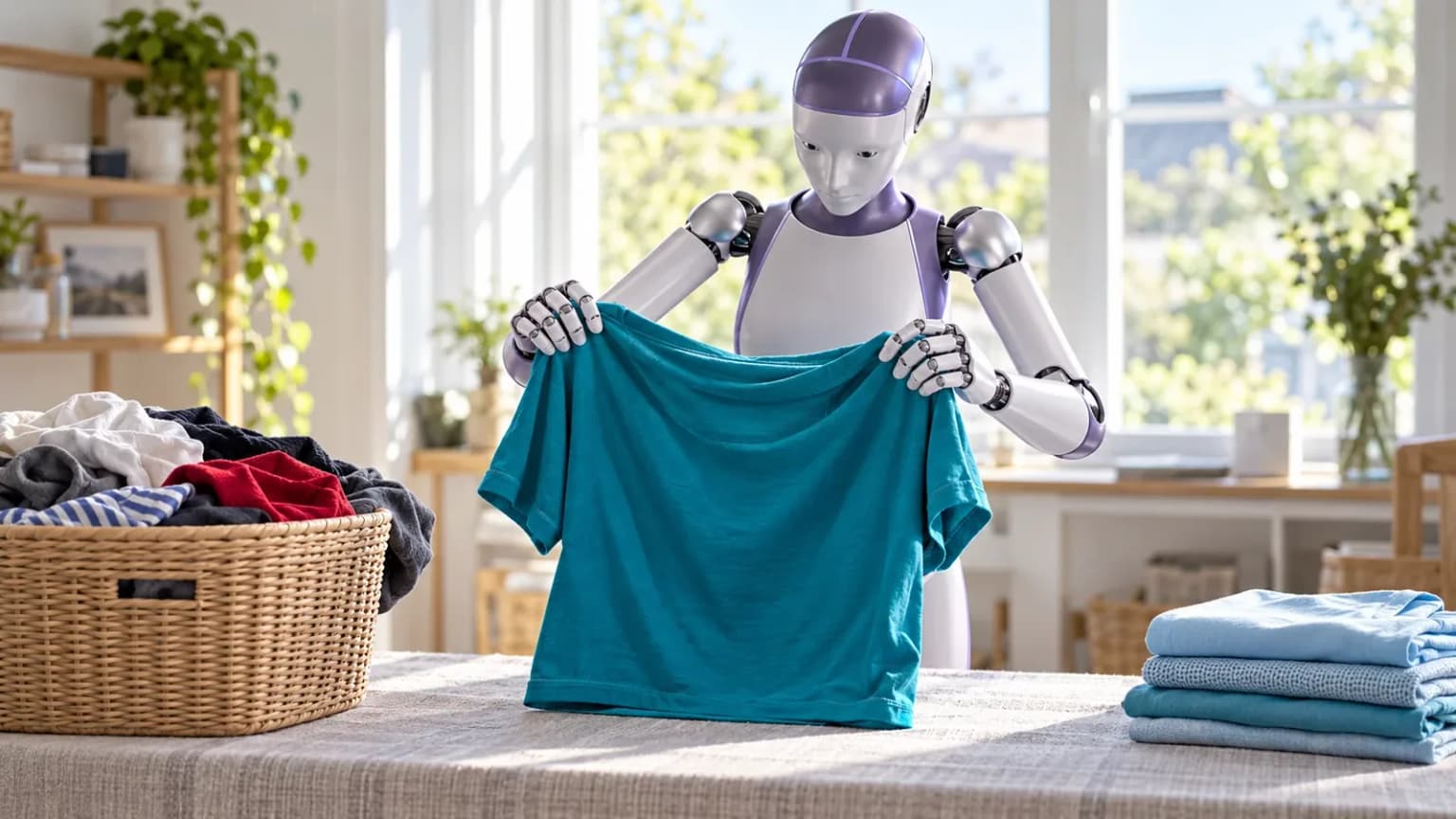
Laundry folding robots already exist, and limited home deployments are beginning. What remains uncertain is when an affordable machine will reliably handle an ordinary household's mixed laundry without frequent assistance. As of September 29, 2026, the sources reviewed do not establish a dependable date for that broader transition.
For example, Weave Robotics says its stationary Isaac 0 is shipping in limited quantities in California. The company describes it as an early-release prototype that combines autonomous operation with remote human assistance. That is a meaningful step toward household automation, but it is not evidence that fully independent laundry care has arrived everywhere.
What can laundry folding robots do today?
Robotic laundry folding has moved beyond a carefully positioned shirt, although performance depends on the machine and the conditions.
In the 2022 SpeedFolding project, researchers from the University of California, Berkeley, and Karlsruhe Institute of Technology demonstrated a two-arm system that smoothed and folded initially crumpled garments. It averaged under 120 seconds per garment with a reported 93% success rate in its experiments. Folding instructions were supplied as fold lines.
Those results demonstrate a research capability, not a guarantee for every fabric or home. They also measure garment folding, rather than the complete journey from a dirty basket to a drawer.
Weave's February 11, 2026, Isaac 0 announcement described a different milestone: a product already in an initial customer's home. It said the robot could take 30–90 minutes per load and that a specialist could intervene remotely when it encountered difficulty. These are manufacturer claims, not independent performance measurements. Why clothes are difficult for robots
The main challenge is that fabric changes shape during handling. A sleeve can disappear underneath a shirt, and grasping one corner can shift the rest of the garment.
SpeedFolding's researchers identify garment dynamics and the many possible configurations of cloth as central difficulties. Their approach first brings a crumpled item into a smooth arrangement before executing folds.
For laundry folding robots, success therefore involves more than repeating an arm movement. Effective laundry folding robots need to identify a useful grip, assess the result, and adjust when the cloth moves unexpectedly.
A helpful way to evaluate this is to imagine a hypothetical basket containing a towel, a tangled long-sleeved shirt, and a delicate top. A convincing demonstration would show how the system handles each item, including any rejected garment or request for help. One successful towel fold cannot answer all those questions.
Autonomous operation and remote help are different
Autonomous means the robot performs the action under its own control. Teleoperation means a person controls or assists it remotely.
Buyers comparing laundry folding robots should ask about both. A system may remove work from the owner while still relying partly on another person's labor.
Weave says Isaac 0's assistance needs vary by garment. Its product page says remote specialists can access head and wrist camera feeds and diagnostic information, while no audio is collected. Its mobile Isaac 1 also advertises autonomy with teleoperation when needed. [1][4]
Remote assistance is not automatically a reason to reject a product. It does change the questions worth asking: when can an operator connect, what can they see, and what happens if connectivity or support is unavailable?
When will robots fold laundry in ordinary homes?
There is no verified mass-adoption deadline. Availability should be assessed in stages rather than reduced to a single predicted year.
| Stage | What it establishes | What remains to be checked |
|---|---|---|
| Research demonstration | A task works under tested conditions | Performance outside that setup |
| Limited home deployment | Selected customers can use a product | Reliability, support, and geographic coverage |
| Broader consumer rollout | More households can order | Delivery dates and suitability for each home |
| Routine household use | Consistent practical value | Long-term costs and maintenance |
Current laundry folding robots occupy different points along this progression.
Weave lists first Isaac 1 shipments for fall 2026, prioritizing California, with broader US availability planned through 2027. A shipping schedule is a company plan, not proof that every listed region has received deliveries. The reviewed product page does not establish a UK launch date.
The most useful milestone will be sustained performance across real households: varied clothing, repeated loads, and clearly reported intervention rates. That is an editorial assessment of readiness, not a forecast of when it will happen.
What is the laundry folding robot cost?
Prices for laundry folding robots are model-specific and may include ongoing charges.
On September 29, 2026, Weave's Isaac 0 page listed either $249 per month or $3,999 upfront plus $49 per month. Isaac 1 listed $449 per month or $7,999 upfront. These are advertised US-dollar prices; buyers should confirm taxes, delivery, service terms, and regional eligibility before ordering.
For laundry folding robots, compare total ownership costs with the work actually removed. Ask whether you still need to separate garments, position individual items, clear the work surface, or refold rejected clothes.
A hypothetical machine that runs for an hour but requires only five minutes of your attention may be more useful than a faster one needing repeated supervision. Measure your active time, not just the robot's speed.
If a purchase would compete with essential savings, Daily US Wire's guide to building an emergency fund provides related household-budgeting context.
What to check before buying
When evaluating laundry folding robots for home use, request evidence that matches your routine:
- Your clothing: Ask for an uncut trial with comparable sizes, fabrics, and garment types.
- Human involvement: Count setup, remote interventions, and corrections by the owner.
- Finished results: Check whether stacks fit your shelves and drawers.
- Space and access: Confirm the work area, movement clearances, and installation requirements.
- Support: Get written repair, cancellation, subscription, and service-continuity terms.
- Data handling: Ask about cameras, recordings, operator access, and retention.
Check conflicting product claims, too. Isaac 0's page mentions bed sheets among handled laundry, but its FAQ says large blankets and bed sheets are not yet folded. Get written clarification before relying on that capability.
What would a genuine takeover look like?
The future of laundry automation will depend on laundry folding robots completing the routine consistently, including recovering from mistakes.
Folding is only one part of laundry care. Sorting, washing, drying, transporting, and putting clothes away create additional requirements. Do not assume that a robot advertised for folding includes all of them.
For now, laundry folding robots are best understood as an emerging option with limited deployment and important conditions. Watch for independently documented household results, transparent assistance rates, and confirmed local support. Those signals will say more about readiness than a polished demonstration or a promised breakthrough year.