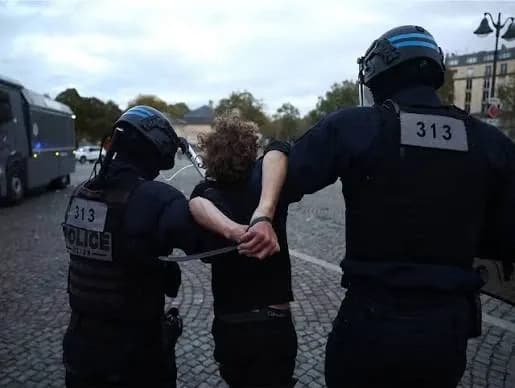

A 19-year-old Illinois man appeared in court on October 14, 2026, in connection with an alleged Hindu temple shooting plot. Alexandros Paporakis, of Palatine, faces felony charges of making a terrorist threat and unlawful weapon possession. A judge ordered him held pending trial, according to Reuters.
The central distinction is that investigators described a potential attack, with a Hindu place of worship in Aurora as a possible target. Police have not confirmed the specific intended location. Readers should not interpret the charges as proof that a shooting occurred or that the defendant has been convicted.
How the alleged Hindu temple shooting plot investigation began
The alleged Hindu temple shooting plot investigation began after troubling communications reached people who knew Paporakis. According to the Associated Press, coworkers reported receiving messages and material describing plans for violence. Mount Prospect and Palatine police coordinated his arrest on Sunday, October 11.
Prosecutors also alleged that Paporakis told a coworker his gun had jammed. That account is an allegation presented by prosecutors, rather than an independently established reconstruction of where he went or what happened there.
The coworkers’ reports are an important part of the case: information shared privately became information investigators could assess. Readers do not need to see the threatening material themselves to understand that sequence.
What investigators say they found
Police said a search of the defendant’s home yielded a rifle, loaded magazines and additional ammunition. They also examined electronic communications and a document attributed to him containing white supremacist views and references to violence against people of South Asian heritage, particularly those of Indian descent. Reuters reported that the FBI was assisting.
These reported discoveries explain why the alleged Hindu temple shooting plot has raised concerns about racially motivated violence. They do not establish guilt by themselves; the evidence and allegations remain subject to the court process.
There is no public-interest need to reproduce racist insults or circulate the document. Describing the alleged bias provides relevant context without turning the suspect’s material into promotional content.
Why the intended location remains uncertain
For readers following the alleged Hindu temple shooting plot, the location question deserves particular care. A possible target is not the same as a confirmed destination. Police explicitly left that issue open in the reporting reviewed for this article.
That distinction should also guide photographs and social media posts. Attaching an unrelated temple’s name or image to the story could wrongly identify a congregation as the intended target. A neutral courthouse image is a more responsible choice until reliable information establishes a specific location.
Likewise, an image of emergency vehicles outside a temple would suggest an on-site response. Unless that photograph is verified and accurately captioned, it could communicate something the written reporting does not establish.
What the terrorist-threat charge means
The charges in the alleged Hindu temple shooting plot concern a threat and weapon possession. The word “terrorist” in the charge should not be treated as evidence of membership in a particular organization.
Under Illinois law, making a terrorist threat involves knowingly threatening a terrorist act with the intent to intimidate or coerce a significant part of the civilian population, while creating a reasonable expectation or fear of an imminent terrorist act. The statute classifies the offense as a Class X felony.
The law also states that certain circumstances do not provide a defense: for example, the threat need not have been communicated directly to its intended victim. This helps explain why communications received by coworkers can matter in a threat investigation. ilga.gov
That is general statutory context, not a determination that prosecutors have proved each requirement in this case. Paporakis is presumed innocent unless proven guilty.
How to evaluate further updates
The next useful developments in the alleged Hindu temple shooting plot will be information that clarifies the evidence and the court proceedings. Readers can assess new reports by asking three questions:
- Who is making the claim: police, prosecutors, a defense attorney or an unnamed social media account?
- Does the report describe an allegation, a filed charge or a finding by a judge?
- Has the information actually changed, or is an earlier claim being repeated with stronger wording?
Pay particular attention to defense responses. A complete account should include the defendant’s position when it becomes available. An absence of comment in early reporting should never be interpreted as an admission.
What to do if you receive a threat
For people concerned by the alleged Hindu temple shooting plot, the practical lesson is to report specific threats and preserve evidence.
The Justice Department advises calling 911 or local police for immediate help in an emergency. People reporting a suspected hate crime should contact local law enforcement and follow up with the FBI through tips.fbi.gov or 1-800-225-5324. Report a Hate Crime
The FBI’s threat guide also advises preserving electronic threats. Do not delete the original message. Record the date and time, and preserve a copy or photograph when it is safe to do so. The original communication may contain information that a screenshot alone cannot show.
Give investigators what you actually received or observed. Keep that separate from assumptions about motive or information passed along by someone else. Reporting a concern allows authorities to assess it; members of the public do not have to decide which criminal charge might apply.