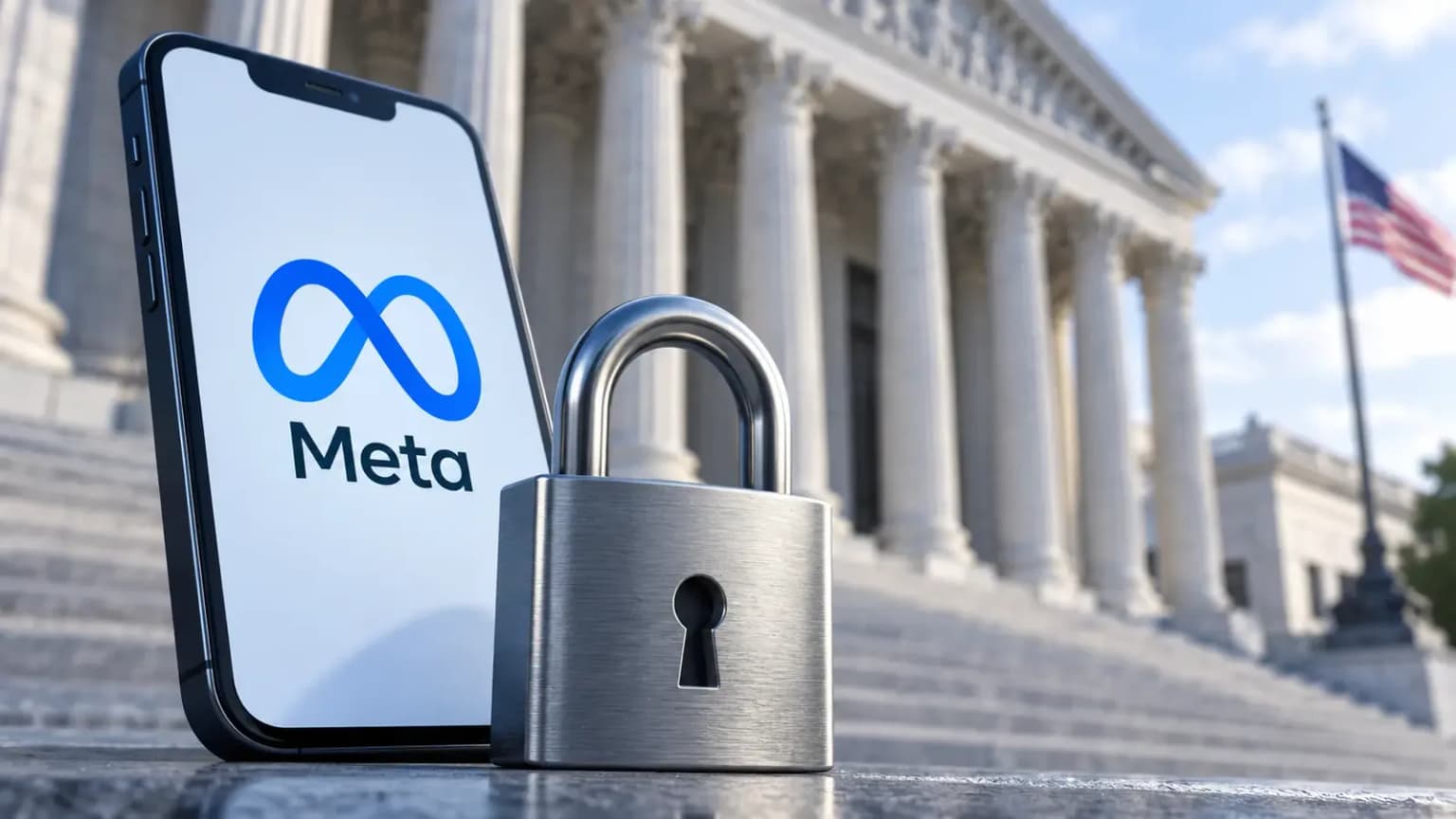
Meta’s $25 billion privacy fine concerns a basic question for Facebook users: did the company accurately explain who could access their information? On October 21, 2026, a New Mexico court ordered the penalty following a jury verdict against the company.
The ruling grew out of the Cambridge Analytica scandal, but its implications reach beyond that episode. It addresses the gap between privacy assurances and actual practices. For readers, three distinctions matter immediately: this is a court order, not proof of payment; it is a state enforcement case, not an automatic user payout; and Meta intends to appeal.
Why was Meta fined $25 billion?
According to the New Mexico Department of Justice, the case examined Facebook’s representations about personal information, third-party access, misinformation, and hate speech. The jury found 43,899,725 violations of the state’s Unfair Practices Act.
The jury established liability; the subsequent court order determined the financial penalty. That distinction explains why reports of a September verdict and an October judgment describe different stages of the same case.
Calling the award a $25 billion privacy fine is useful shorthand, but the state’s case was broader than a single data leak. It challenged what Facebook told people about how its platform operated.
For consumers, the central issue is understandable: a privacy setting has limited value if the explanation surrounding it gives people an inaccurate picture of what they control.
How the violation count became so large
Reuters reported that jurors found 26 of 29 statements by Meta and its leadership misleading. Violations were counted using the Facebook users or New Mexico residents who constituted the audience for those statements.
The figure therefore should not be read as nearly 44 million separate hacking incidents or that many individual New Mexico residents.
This is an important way to interpret the $25 billion privacy fine: repeated representations reaching large audiences can produce a much larger violation count than the number of statements alone suggests.
Avoid dividing the award by Facebook’s worldwide user count to estimate compensation. That calculation would confuse the basis for a government penalty with eligibility for an individual payment.
How Cambridge Analytica obtained Facebook information
The historical background helps explain why the $25 billion privacy fine has revived concerns about connected apps.
In its 2019 enforcement announcement, the Federal Trade Commission described a personality-survey application developed by Aleksandr Kogan. The agency alleged that the app collected information about participants and their Facebook friends, including people who never used the app themselves.
According to the FTC, the information supported personality scoring, which was matched with voter records for profiling and targeted advertising. The agency also alleged that assurances about not collecting identifiable information were false.
A hypothetical example makes the distinction clearer: you decline to install a quiz app, but a friend installs it. If the platform lets that app access information about friends, your decision alone may not prevent collection. This illustrates the historical access problem; it is not a claim that every current Facebook app has those permissions.
The lesson is to ask both what information you provide directly and what other routes might make it available.
What Meta says about the ruling
Meta disputes the case. Reuters reported that the company argued in court filings that it does not sell user data and that New Mexico had not proved any consumer was actually misled.
After the ruling, chief legal officer C.J. Mahoney said Meta expected to prevail on appeal and characterized the enforcement action as a restriction on speech, according to reporting published by the Los Angeles Times and carried by AOL.
The $25 billion privacy fine is therefore an ordered penalty that Meta plans to challenge. Announcing an appeal does not itself erase a judgment, but readers should not assume the amount has been collected or that every legal dispute is over.
Future coverage of the $25 billion privacy fine should identify what actually changes: a filed appeal, a court decision, a revised award, or confirmed payment.
Does the $25 billion privacy fine include user payouts?
The $25 billion privacy fine should not be mistaken for a compensation program open to Facebook users.
Reuters reported that New Mexico Attorney General Raúl Torrez said state law directs the penalty money to the state’s school system. That is different from a settlement that establishes a claims process for eligible individuals.
For US and UK readers alike, the headline alone supplies no basis for expecting a personal payment.
Before treating any message as a legitimate payout notice, look for three things: the exact case name, an identifiable court-approved administrator, and an official explanation of eligibility. A large dollar amount in a news story supplies none of those details.
How this differs from the earlier FTC penalty
Facebook previously agreed to a $5 billion FTC settlement announced in July 2019. That action concerned allegations that the company violated a 2012 privacy order. It also imposed privacy oversight requirements.
The $25 billion privacy fine comes from New Mexico’s separate state proceeding. The shared Facebook privacy background does not make the two amounts interchangeable.
| Action | Authority | Key distinction |
|---|---|---|
| $5 billion settlement announced in 2019 | Federal Trade Commission | Resolved alleged violations of an earlier FTC order and added oversight requirements |
| $25 billion penalty ordered in October 2026 | New Mexico state court | Followed a jury finding violations of state consumer protection law |
The comparison also shows why the size of a penalty is only one measure of an enforcement action. For users, changes to access, oversight, and disclosure deserve attention alongside the money.
What Facebook users can check now
The $25 billion privacy fine offers a reason to review account choices, but a settings review cannot resolve the company’s legal responsibilities.
Meta’s Privacy Checkup guidance describes controls covering who can see information, account security, discoverability, and apps connected through Facebook. about.fb.com
A useful review starts with three questions:
- Who needs to see this? Review the audience for posts and profile details such as your phone number. Choose an audience deliberately before sharing sensitive information.
- Which connections do I still need? Review apps linked through Facebook and remove those you no longer use. Keep a short list of services you recognize and still rely on.
- What does each control actually promise? Read the explanation beside a setting. A control over post visibility should not be assumed to govern every other use of information.
Treat this as routine account maintenance. The $25 billion privacy fine does not establish that every account has been newly compromised, and changing a setting should not be presented as reversing historical data collection.
For broader coverage of technology oversight, read Daily US Wire’s article on Brad Smith’s call for stronger AI safeguards.