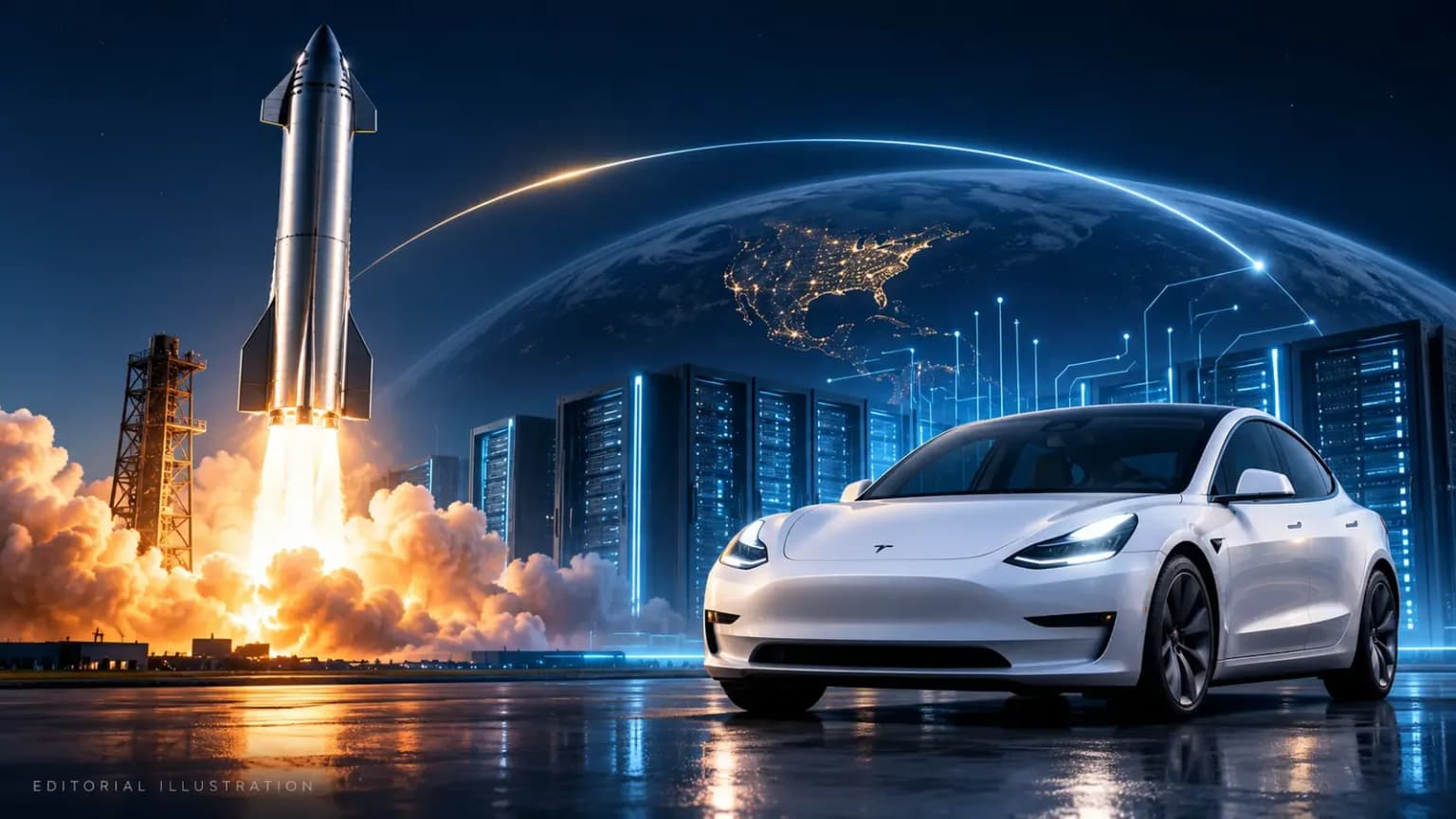
The proposed SpaceX Tesla merger raises a question bigger than whether rockets and electric cars belong together: would combining the companies create more value than letting them cooperate independently?
Elon Musk’s stated rationale centers on artificial intelligence, chips, robotics and connectivity. He believes those businesses increasingly overlap. But as of October 22, 2026, the discussions remain exploratory. Musk said independent board committees were considering a combination and had not agreed on transaction terms. A completed deal is far from assured.
For shareholders, the important questions are practical: what would each side receive, who would control the combined business, and which projects would get its money?
What has actually been announced?
During SpaceX’s October 20 earnings call, Musk said both companies had formed special committees of independent directors at shareholders’ request. He described himself as conflicted and said he could not participate in those committees’ discussions.
He also cautioned against assuming a transaction was certain. His support for the SpaceX Tesla merger represents an executive’s preference; the committees still have to negotiate acceptable terms, and shareholders would have to support a proposed transaction.
That distinction matters when reading headlines. Exploratory talks do not establish an acquisition price, exchange ratio or closing date. Predictions about those details should be treated as scenarios until the companies disclose an agreement.
Why Musk sees a business case
AI could connect several different businesses
The clearest argument for a SpaceX Tesla merger is that both companies increasingly need computing infrastructure, advanced software and specialized hardware.
On the earnings call, Musk identified potential cooperation in AI software, chip design, robotics, connectivity and Terafab, the chip initiative. Those are his stated reasons for supporting a combination. They are not evidence that every proposed benefit will materialize.
The underlying logic is understandable. If different products require related computing tools, common ownership could make it easier to set priorities, allocate engineers and coordinate investment. Whether that improves results depends on how much technology the businesses can actually share.
Energy and computing create another connection
Tesla’s third-quarter update describes investment across robotics, computing and energy. It also identifies energy storage as important to data-center reliability and expects rising data-center demand to support its storage business.
That suggests a possible commercial connection: computing facilities need dependable electricity, while storage suppliers can help manage power availability. A SpaceX Tesla merger could bring more decisions about computing and energy investment under one board.
However, common ownership does not generate electricity or remove construction bottlenecks. Any business case must explain how integration would improve delivery, costs or reliability beyond what supply agreements already allow.
Some financial ties already exist
Tesla’s 2026 proxy statement documents an existing investment relationship. It says Tesla completed an approximately $2 billion investment in SpaceX shares in March, following SpaceX’s acquisition of xAI Holdings. The filing also describes commercial arrangements between Tesla and SpaceX.
These disclosures help explain why the SpaceX Tesla merger attracts attention. The companies already have connections that extend beyond a shared leader.
They also sharpen the central test: which additional benefits require a full merger?
The question cooperation alone cannot answer
A useful way to assess the SpaceX Tesla merger is to compare it with the strongest realistic alternative: continued collaboration between separate companies.
| Proposed benefit | What shareholders should ask |
|---|---|
| Shared chip development | What would ownership improve beyond a joint project? |
| Coordinated computing investment | How much spending would be avoided, and when? |
| Access to energy storage | Why would a supply contract be insufficient? |
| Shared research and engineering | Which teams and technologies would actually overlap? |
| Combined financing | Who would fund each project and bear its losses? |
This is an analytical framework, not a list of promised merger benefits.
The strongest proposal would quantify savings, identify responsible managers and explain implementation costs. A broad vision can establish direction, but shareholders need enough detail to compare that vision with keeping their existing investments separate.
How a transaction could work
No final structure has been disclosed in the sources reviewed. One possibility discussed by analysts is a transaction in which Tesla shareholders receive SpaceX shares. Reuters reported disagreement over the premium Tesla investors might demand and the dilution SpaceX investors might accept.
In a stock-based SpaceX Tesla merger, the exchange ratio would specify how many acquiring-company shares investors receive for each share they surrender.
Hypothetical example: Suppose an offer provides 0.75 shares of Company A for each share of Company B. If Company A trades at $400, the offer is worth $300 per Company B share. If Company A falls to $320, that same fixed ratio is worth $240.
Those figures are illustrative and do not represent proposed terms. They show why a headline deal value can change before closing. Investors also need to examine whether an agreement includes protections against large price movements.
The biggest risks for shareholders
Price and control could divide the two sides
A SpaceX Tesla merger could appeal to investors in principle while still producing disagreements over the terms. Tesla shareholders could seek a higher price; SpaceX shareholders could resist issuing additional shares to pay it.
Voting rights deserve equal attention. Reuters reported substantial differences between Musk’s voting influence at the two companies. The effect of any transaction would depend on its eventual structure and share classes.
An investor’s percentage of economic ownership and ability to influence decisions can differ. Both belong in the assessment.
A larger budget also means competing demands
The SpaceX Tesla merger would raise questions about how managers allocate money among businesses with different development schedules and risks.
Tesla’s latest update illustrates the demands on its own finances: third-quarter capital expenditures were approximately $4.7 billion, while free cash flow was approximately $1.5 billion. Free cash flow measures operating cash left after capital spending under the company’s definition.
Combining companies would not eliminate trade-offs. Shareholders should ask whether each major project has a funding plan and measurable milestones, and whether established businesses could end up supporting speculative projects for longer than expected.
Negotiating an agreement would be one step
The SpaceX Tesla merger would still face the conditions written into any eventual agreement, including applicable shareholder and regulatory requirements.
The Federal Trade Commission explains that certain large transactions require advance notification to U.S. antitrust authorities and cannot close until the applicable waiting period has ended or been terminated early. That general process does not establish whether regulators would challenge this particular proposal
What readers should watch next
The next meaningful development in the SpaceX Tesla merger would be a company disclosure that provides terms people can evaluate.
Look for the transaction structure, exchange ratio, voting rights, financing commitments, projected savings and termination conditions. Also check what the independent committees say about the alternatives they considered.
For background on the engineering ambitions involved, see Daily US Wire’s explanation of Starship and reusable space travel.
Musk has explained why he favors closer integration. The next test is whether a SpaceX Tesla merger proposal shows that shareholders on both sides would benefit from paying for it.