France shut or partly shut as many as 500 high schools on Monday, October 5, 2026, the third week of the largest wave of student unrest the country has seen in years. Education Minister Édouard Geffray announced the closures on Sunday, saying lessons would be "totally or partly suspended" at 400 to 500 lycées because security conditions "have not been fulfilled" (Al Jazeera/AFP, Oct. 4).
If you are trying to make sense of the France school protests from the United States, here is the short version. Teenagers at public high schools began blockading their buildings in mid-September over crowded classes and missing teachers. The movement spread nationally, some protests turned violent, and the government is now closing schools as a safety measure while student organizers plan to march again on Tuesday.
This article explains what set the protests off, how a national school closure actually works in France, what the numbers mean, and what to watch this week. Figures are current as of Monday morning US time and will change.
What happened Monday
- Up to 500 of France's roughly 3,700 public high schools were fully or partly closed, a number Geffray said would be comparable to Friday, when the Education Ministry counted at least 400 closed and 560 disrupted.
- The Paris region was hit hardest. Valérie Pécresse, president of the Île-de-France regional council, told Franceinfo that more than a third of the region's 468 high schools would be closed (South China Morning Post/AFP).
- Geffray said 24 schools had been "burned or ransacked" since the movement began, and that at least 170 students and 78 school staff had been injured.
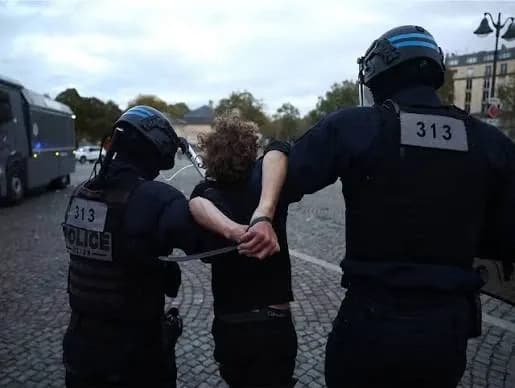
- The interior minister reported more than 5,000 arrests in the previous week, about 85 percent of them minors.
The government framed the closures as a pause, not a shutdown. Geffray promised a "partial, progressive return to lessons," meaning individual schools reopen as local officials judge them safe.
What set off the France student protests
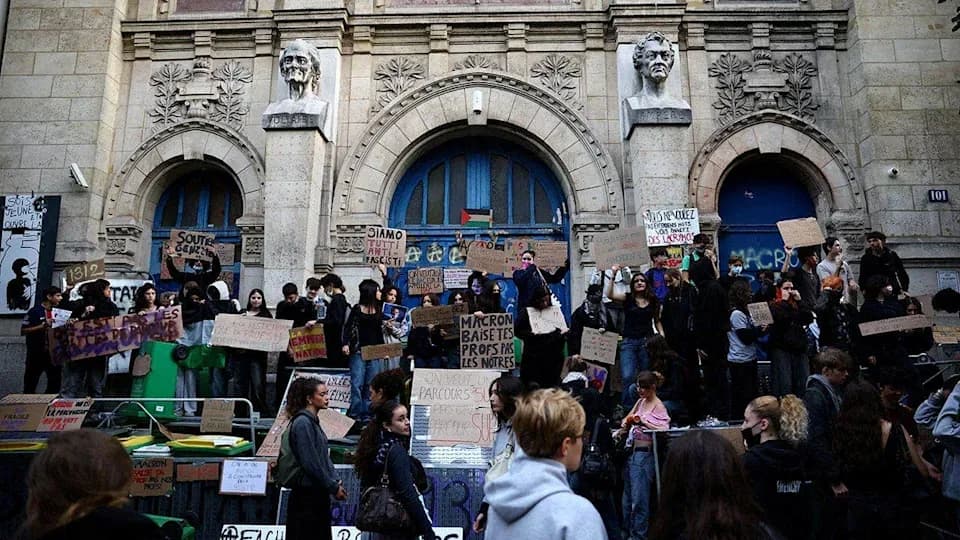
The movement started small. On September 17, teachers and students at a single high school in a Paris suburb walked out over missing teachers and long school days. Within two weeks, blockades had spread to Lille, Lyon, Bordeaux, Rennes, Nantes, Marseille and Montpellier.
The grievances are concrete and mostly about daily conditions rather than ideology:
- Class sizes. Student union leader Ryad Rani cited classes of 32 to 35 pupils.
- Absent, unreplaced teachers. When a teacher is out sick, French schools often have no substitute, so the class simply does not happen.
- Long days. Students in Paris carried signs reading "8am-6pm. More hours of lessons than sleep."
- Run-down buildings. June heat waves exposed poorly insulated classrooms with no air conditioning, according to Vincent Latour, a professor at Université Toulouse Jean Jaurès.
Timing turned a local complaint into a national one. The student blockades landed on top of a public-sector strike on September 29 against a 2027 budget that includes roughly 54 billion euros (about $61 billion) in cuts and a proposed fourth straight freeze on civil-servant base pay. Teachers' unions said students and staff were angry about the same classrooms. The Education Ministry put teacher participation in that strike at just over 11 percent.
The politics are heated. Prime Minister Sébastien Lecornu condemned the violence and accused opponents of fueling it. Left-wing leader Jean-Luc Mélenchon accused the government of a crackdown on teenagers. Geffray has claimed far-left activists "infiltrated" the movement, a charge student organizers reject. Amnesty International said the students "must be listened to, not repressed". Those are competing claims, not established facts, and a presidential election next spring colors every statement from every side.
How schools get closed in France, and why Washington couldn't do this
The headline "France closes 500 schools" sounds like a single switch flipped in Paris. The reality is more layered, and it explains why the count keeps moving.
French public education is a national system. The Ministry of National Education hires and pays teachers and sets the curriculum. Regional governments own and maintain the high school buildings, which is why Pécresse, a regional president, is the one giving numbers for the Paris area. Day to day, a school principal (the proviseur) working with the ministry's regional office decides whether a specific building is safe to open. "Partly closed" usually means some classes run while others are suspended, or the building opens but students who want to blockade it are allowed to stay outside.
So when Geffray says 400 to 500 schools, he is reporting the sum of hundreds of local decisions, filtered through a national chain of command that can push them in one direction. That is roughly the opposite of the American setup. The US has no national schools authority with that power. Closures here are made by about 13,000 independent school districts, which is why even during the 2020 pandemic, decisions varied county by county.
A simple way to read the daily numbers
French officials are releasing three different counts, and news reports sometimes blur them. A hypothetical example: a city with 20 high schools might report 5 closed, 3 partly closed, and 12 with students blockading the gates but classes technically running. A wire report could call that "8 closed" or "20 affected." Both are defensible. When you see a figure, check which column it belongs to:
|
Term used |
What it means |
Friday, Oct. 2 (ministry) |
|---|---|---|
|
Closed |
No lessons at all |
at least 400 |
|
Partly closed |
Some lessons suspended for safety |
included in the 400–500 Monday estimate |
|
Affected / disrupted |
Blockade, strike or protest on site, lessons may continue |
560 |
Source: Al Jazeera/AFP. France has about 3,700 public high schools, so even the high estimate means roughly one in seven is affected, concentrated around Paris.
Why student protests in France carry more weight than US walkouts
Americans tend to picture a student protest as a one-day walkout: kids leave class, make a point, come back tomorrow. France has a different tradition, and understanding it explains why the government is closing buildings instead of waiting it out.
High school and university students in France have a track record of forcing policy changes. In 2006, weeks of student-led protests pushed President Jacques Chirac to scrap a youth labor contract that would have made it easier to fire young workers; the Sorbonne stayed closed for six weeks (Fox News/AP, 2006). In 2018, students blockaded campuses over university admissions reforms (AP via PressReader). In November 2020, Paris high schoolers clashed with riot police over crowded classrooms during COVID, demanding class sizes be halved. The blockade, with trash bins stacked at the school gate, is a recognized form.
Three things make the 2026 wave different from those precedents:
- Scale. Roughly 735 schools affected and more than 5,000 arrests in a week, by AFP's count, is far beyond the 20 or so Paris schools blocked during the 2017 election protests.
- The demands are about resources, not a specific law. Chirac could withdraw one contract. There is no single bill Macron's government can pull to end a protest about class sizes and absent teachers, especially while it is trying to pass 54 billion euros in cuts.
- The election clock. France votes for president next spring. Every party has an incentive to claim the students or blame the government, which makes a quiet settlement harder.
For US readers, the closest parallel is not a campus protest but the 2018–19 teacher strikes in West Virginia, Oklahoma and Arizona, which closed schools statewide over pay and funding. The difference is that in France, the people at the barricades are 15 to 18 years old.
What to watch this week
The next 72 hours will show whether Monday's closures were a pause or the start of a longer shutdown. Four signals matter more than the daily headline count:
- Tuesday's turnout. Organizers called for renewed large-scale demonstrations on Tuesday, October 6, saying the government has offered no "concrete measures". A big Tuesday means more closures Wednesday.
- A government offer. Watch for an announcement on substitute-teacher hiring or class-size caps. That is the only kind of concession that addresses what students say they want. A promise of dialogue without money is unlikely to end it.
- University spread. A student union says about 30 campuses, including in Paris and Marseille, were already blocked (Business Standard). If universities join in force, the movement gains adult organizers and staying power.
- Injury reports. Allegations of a student losing teeth to a rubber bullet and another hit in the eye are circulating but are not independently confirmed (CP24/AFP). A verified serious injury has historically been the moment French protests escalate.
If you are traveling to France
School protests have not closed airports, rail lines or tourist sites. Demonstrations cluster near high schools and city squares on weekdays, mostly mornings. Check the US State Department's France travel page and avoid areas where police vans are massing. Public-sector strikes, which can disrupt trains and flights, are a separate calendar and worth checking on their own.
Common questions
Are all schools in France closed?
No. Elementary and middle schools are open. The closures affect lycées, the public high schools for ages 15 to 18, and even there most of the roughly 3,700 are operating.
Is this about Macron?
Indirectly. The students' demands are about classrooms, but the protests landed during a budget fight and a pre-election season, so they have become a referendum on the government's spending plans.
Why are so many of those arrested minors?
Because the protesters are high schoolers. The interior ministry says about 85 percent of the 5,000-plus people detained in the past week were under 18. Rights groups have questioned whether the police response has been proportionate; the government says officers are protecting students who want to attend class.
The bottom line
France did not close 500 high schools because of a policy decision. It closed them because the state, which runs every one of them, judged it could not keep them safe while teenagers blockaded the gates over conditions the state itself controls. Tuesday's turnout will tell you whether this is ending or escalating. Facts in this article are as of Monday, October 5, 2026, and will be updated as official counts change.