
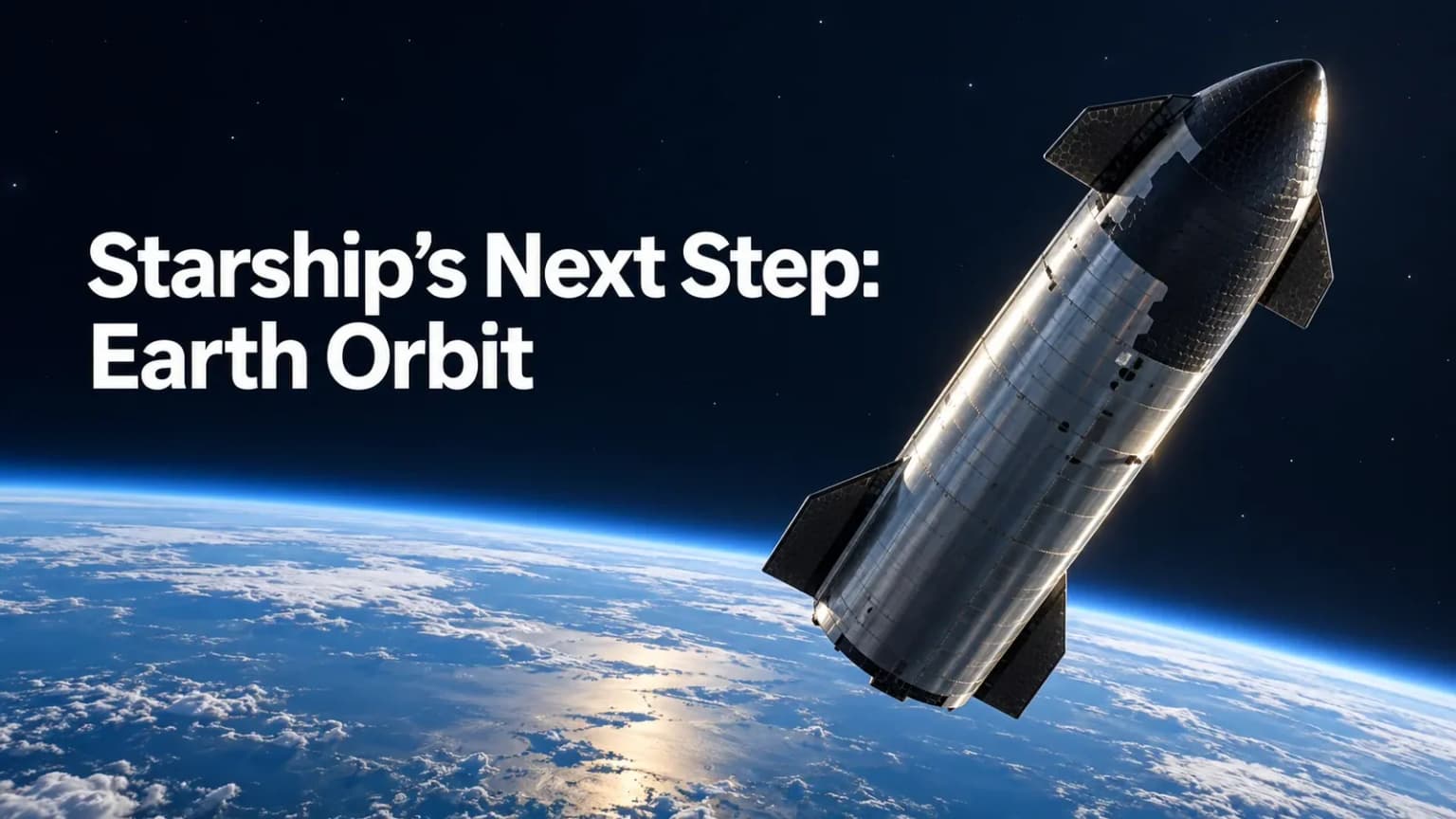
SpaceX Starship Orbital Flight: Why It Could Reshape Space Travel
A successful SpaceX Starship orbital flight would mark more than another spectacular launch. It would show that the enormous spacecraft can enter an Earth orbit suitable for sustained operations, bringing SpaceX closer to delivering payloads with a system designed for full reuse. It would not, by itself, prove that Starship can fly cheaply, frequently or safely with passengers.
As of this prelaunch update on September 28, 2026, SpaceX’s published schedule lists Flight 14 for that date, with a window beginning at 12:15 UTC: 8:15 a.m. Eastern Daylight Time, 7:15 a.m. in Texas and 1:15 p.m. British Summer Time. A listed launch window remains a target, not confirmation of liftoff. www.spacex.com
The potentially transformative development is what could follow: more capacity in orbit, different spacecraft designs and a stronger foundation for missions beyond Earth. Each depends on capabilities that an orbital test alone cannot establish.
What Makes the SpaceX Starship Orbital Flight Different?
Flight 14 is intended to move Starship from suborbital testing into an operationally useful orbit.
Aviation Week reported on September 18 that SpaceX was targeting an orbit roughly 171 miles, or 275 kilometers, above Earth. The planned mission would last nearly ten hours and attempt to place 26 Starlink V3 satellites into orbit. Those are mission objectives, not completed achievements. aviationweek.com
The distinction matters because reaching space and staying in orbit are different accomplishments. A spacecraft can climb above most of the atmosphere yet follow a trajectory that brings it back down without completing a circuit of Earth.
An orbit requires sufficient sideways speed for the vehicle to keep falling around the planet. The European Space Agency explains that a circular orbit about 300 kilometers high requires approximately 7.8 kilometers per second, or 17,500 miles per hour. www.esa.int
For the SpaceX Starship orbital flight, achieving the right speed and trajectory is the milestone that separates an orbital mission from another journey through space.
How Starship and the Super Heavy Booster Work Together
Starship is the name of both the complete launch system and its upper-stage spacecraft. The Super Heavy booster provides the initial propulsion; after separation, the upper stage continues toward its destination.
SpaceX describes the system as designed for full reusability and advertises a payload capability exceeding 100 metric tons in a reusable configuration. These are design claims, not proof that every test flight carries that mass or demonstrates rapid reuse. new.spacex.com
This is where two ambitions can become confused. Delivering a payload requires successful ascent and deployment. Making the system economical over many missions also requires recovering hardware and preparing it for another flight without excessive expense or delay.
The SpaceX Starship orbital flight should therefore be judged against its announced objectives, rather than every long-term promise associated with the vehicle.
What Success Would and Would Not Prove
The SpaceX Starship orbital flight is one part of a much longer development process. The following distinctions provide a practical way to assess the results.
| Milestone | What it demonstrates | What remains unproven |
|---|---|---|
| Reaching the intended orbit | The vehicle achieves the required trajectory | Reliable performance over repeated missions |
| Deploying satellites | Payload release works under flight conditions | Long-term satellite health and service quality |
| Completing a controlled return | The tested return sequence works | Recovery and economical refurbishment |
| Flying recovered hardware again | Reuse is possible for that hardware | Routine, rapid and profitable operations |
This framework also avoids an overly simple success-or-failure verdict. A mission could achieve its payload objective while encountering difficulties later. Reporting should identify which milestones were completed and which were missed.
Why the Economics Could Matter More Than the Rocket’s Size
The commercial promise behind the SpaceX Starship orbital flight comes from combining payload capacity with repeatable operations.
As an economic inference, spreading hardware costs across more flights could reduce the cost of delivering cargo. However, that outcome depends on refurbishment, staffing, infrastructure, reliability and how much paying payload each mission carries. A large vehicle does not automatically translate into low customer prices.
Consider a hypothetical satellite operator choosing between launch services. Extra capacity may be attractive, but an unsuitable destination orbit or an uncertain departure date can outweigh a lower advertised price. Customers buy delivery to a useful location on a workable schedule, not capacity in isolation.
If Starship eventually offers both capacity and dependable service, designers could reconsider constraints that currently favor compact spacecraft. Larger structures or heavier instruments might become more practical. That is a potential consequence of mature operations, not a result established by one test.
Starship’s Impact on Space Exploration Goes Beyond Earth Orbit
The SpaceX Starship orbital flight also matters for NASA’s lunar ambitions, where dependable transportation is only the starting point.
The agency is developing Starship’s Human Landing System, or HLS, with SpaceX to carry astronauts between lunar orbit and the Moon’s surface. NASA’s published mission concept includes an uncrewed lunar landing demonstration before the crewed landing. www.nasa.gov
Getting that lander to the Moon requires more than launching it. NASA’s Office of Inspector General describes an architecture involving a propellant depot and multiple tanker flights, followed by refueling the lander in Earth orbit. oig.nasa.gov
In practical terms, this turns lunar preparation into a sequence of connected operations: launch, rendezvous, docking, propellant transfer and departure. A reliable orbital vehicle is foundational, but the sequence must also work as a system.
For U.S. and UK readers following lunar exploration, the SpaceX Starship orbital flight is therefore part of a much larger engineering effort. Progress in Earth orbit can support deep-space missions without making their remaining engineering challenges disappear.
What to Watch During the SpaceX Starship Orbital Flight
During the SpaceX Starship launch, the most useful updates will establish the achieved orbit, payload deployment results and the outcome of the return sequence. SpaceX’s mission report should be distinguished from early broadcast impressions, especially when flight data are still being reviewed.
Afterward, watch for evidence of repeatability: subsequent flights, hardware inspections and demonstrated turnaround times. Those developments will reveal more about commercial readiness than a dramatic launch image.
The SpaceX Starship orbital flight could become a significant step toward a different future of space travel. Its importance lies in connecting a powerful launch vehicle with useful orbital operations and eventually with repeatable service.
Orbit would be a major milestone. The wider transformation would come from proving that Starship can deliver, return and fly again reliably enough to change how missions are planned and paid for.