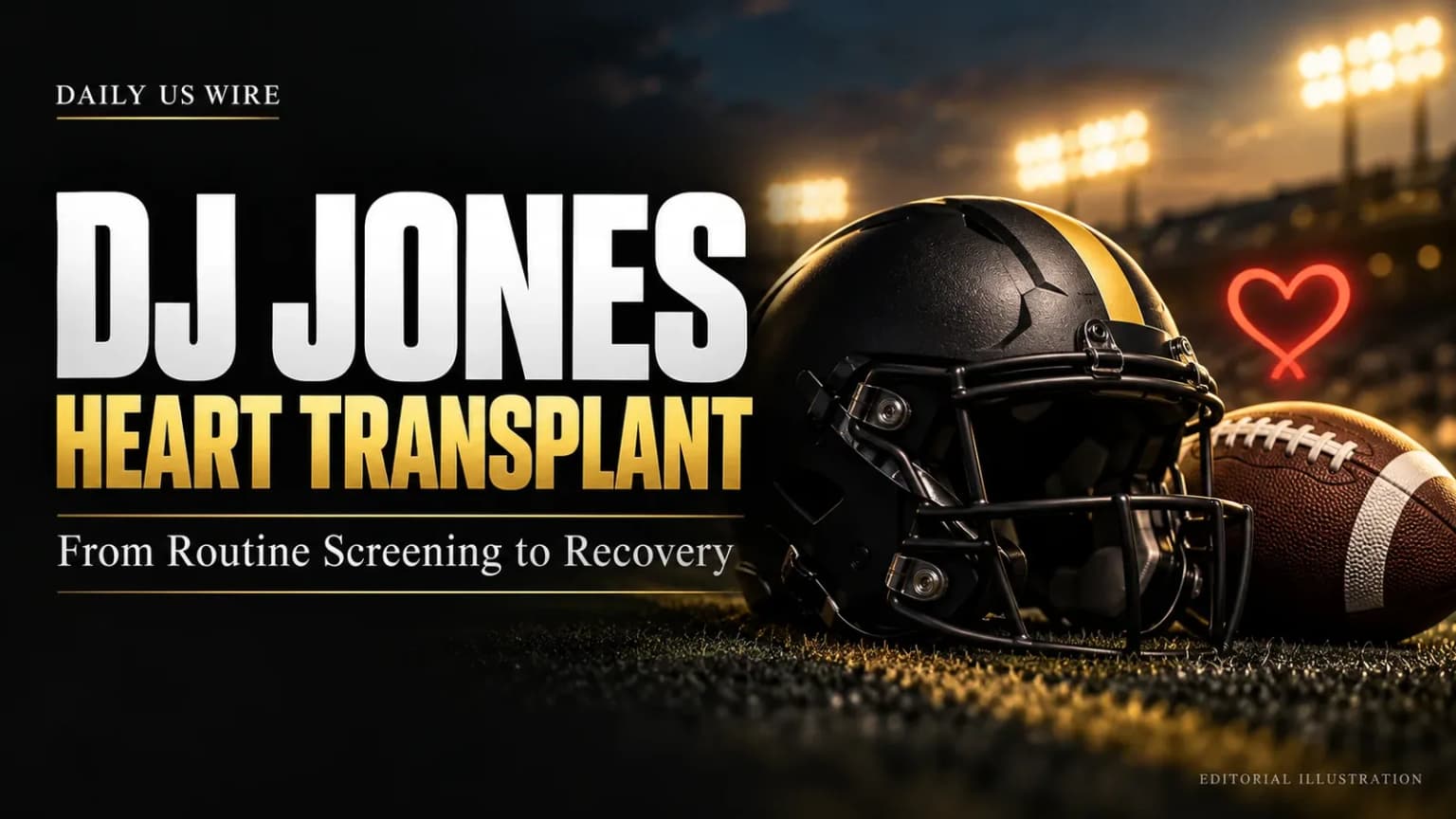
The DJ Jones heart transplant followed a heart problem detected during routine freshman medical testing at Missouri. The 18-year-old offensive lineman underwent surgery Wednesday night, October 7, 2026, and coach Eli Drinkwitz announced the next morning that the operation went well and Jones was recovering.
That encouraging update answers the most immediate question for Missouri fans. But the path from a summer screening to transplantation also raises others: What did doctors find, why was further testing necessary, and what does recovery involve?
The public account explains the sequence of events. It does not provide enough medical detail to identify Jones’ underlying disease or predict his recovery.
How routine testing led to specialist care
According to Drinkwitz’s account, reported by Sports Illustrated, Missouri’s medical staff noticed a heart issue during summer testing of incoming freshmen. After monitoring Jones for roughly two weeks without reaching a resolution they considered satisfactory, the staff sought further evaluation at Mayo Clinic in Jacksonville, Florida.
Specialists there identified a more serious problem. By the week before the coach’s October 6 news conference, the team had learned Jones needed a transplant.
The important distinction in the DJ Jones heart transplant story is that screening began the investigation. The initial finding was followed by observation, referral and specialist assessment; it was not publicly described as one test that immediately produced a transplant decision.
The exact screening test has not been identified in the reporting reviewed. Calling it an electrocardiogram, an ultrasound or a stress test would add a detail that has not been established.
DJ Jones heart transplant: The confirmed timeline
Separating the dates helps explain why older reports describe Jones as waiting for surgery while newer ones describe his recovery.
Field Level Media’s October 8 report confirms the transplant and the earlier public announcement. For readers following the DJ Jones heart transplant, the latest verified milestone in those reports is the start of recovery, rather than a discharge or a return to football.
Who is Missouri’s Johnnie “DJ” Jones?
Jones is a freshman offensive lineman who played at Venice High School in Florida. Missouri’s official December 3, 2025, signing announcement lists Johnnie “DJ” Jones among the players joining its program for the 2026 season.
The university identified him as an offensive line recruit from Florida. That background matters because searches for “DJ Jones” can otherwise leave readers unclear about which player is involved.
Coverage of the DJ Jones heart transplant concerns a teenager at the beginning of his college career. His recruiting profile provides context, but his medical progress is now the meaningful measure of what happens next.
What has been disclosed about his heart condition?
The reports reviewed establish a serious heart problem requiring transplantation. They do not identify its precise cause, provide his test results or describe every treatment considered before surgery.
Those gaps matter. A transplant announcement cannot, by itself, establish whether someone had an inherited condition, an infection or another disease.
Mayo Clinic explains that a heart transplant replaces a failing heart with a donor heart and is generally considered when medicines or other treatments have not helped enough. Several different conditions can lead to that point.
That is general medical context, not a diagnosis of Jones. The DJ Jones heart transplant should not be used to support speculation about what caused his illness, and readers should be cautious with posts claiming a specific cause without an attributable medical or family statement.
What recovery after a heart transplant involves
Drinkwitz’s positive surgical update is significant, but surgery and recovery are separate milestones. The DJ Jones heart transplant recovery process has not been publicly mapped out in detail.
In general, Mayo Clinic describes close monitoring after transplantation, frequent early appointments and ongoing checks for complications. Patients take medicines that suppress the immune system so it is less likely to attack the donated heart. This immune response is called rejection.
These medicines also increase susceptibility to infection, which is one reason follow-up care matters even when a patient feels better.
Mayo Clinic’s guidance explains that recipients remain under a transplant team’s care and that rehabilitation supports recovery. Regaining strength and managing a long-term care routine take time.
None of that establishes Jones’ hospital discharge date or sports eligibility. Any prediction about the DJ Jones heart transplant ending in a particular football comeback would go beyond the information currently available.
What athletes and families can take from this
The useful lesson is the importance of completing an evaluation when screening raises a concern.
The American Heart Association’s 2025 scientific statement with the American College of Cardiology emphasizes screening that includes personal and family medical history and a physical examination. An ECG, which records the heart’s electrical activity, can also be reasonable when qualified interpretation and follow-up resources are available.
The DJ Jones heart transplant does not establish that every young athlete needs the same tests. Families can, however, bring practical questions to a sports physical:
- What personal symptoms and family history should we discuss?
- Did anything in the examination require another appointment?
- Who will explain any abnormal result and arrange follow-up?
- Should activity change while further evaluation is underway?
These questions help turn a screening result into a clear plan. Decisions about testing and participation belong with the athlete’s healthcare professionals.
What to watch for in the next update
The next meaningful DJ Jones heart transplant update would be an authorized statement about his recovery, discharge or rehabilitation. Until then, “surgery went well” should be understood as encouraging early news, without treating it as a complete prognosis.
Fans can support Jones by respecting the medical information he and his family choose to share. When checking new reports, look for the date and the original source: an older story about awaiting a donor can remain searchable after surgery has happened.
For now, the priority is giving a young player room to recover, with future milestones guided by his transplant team.