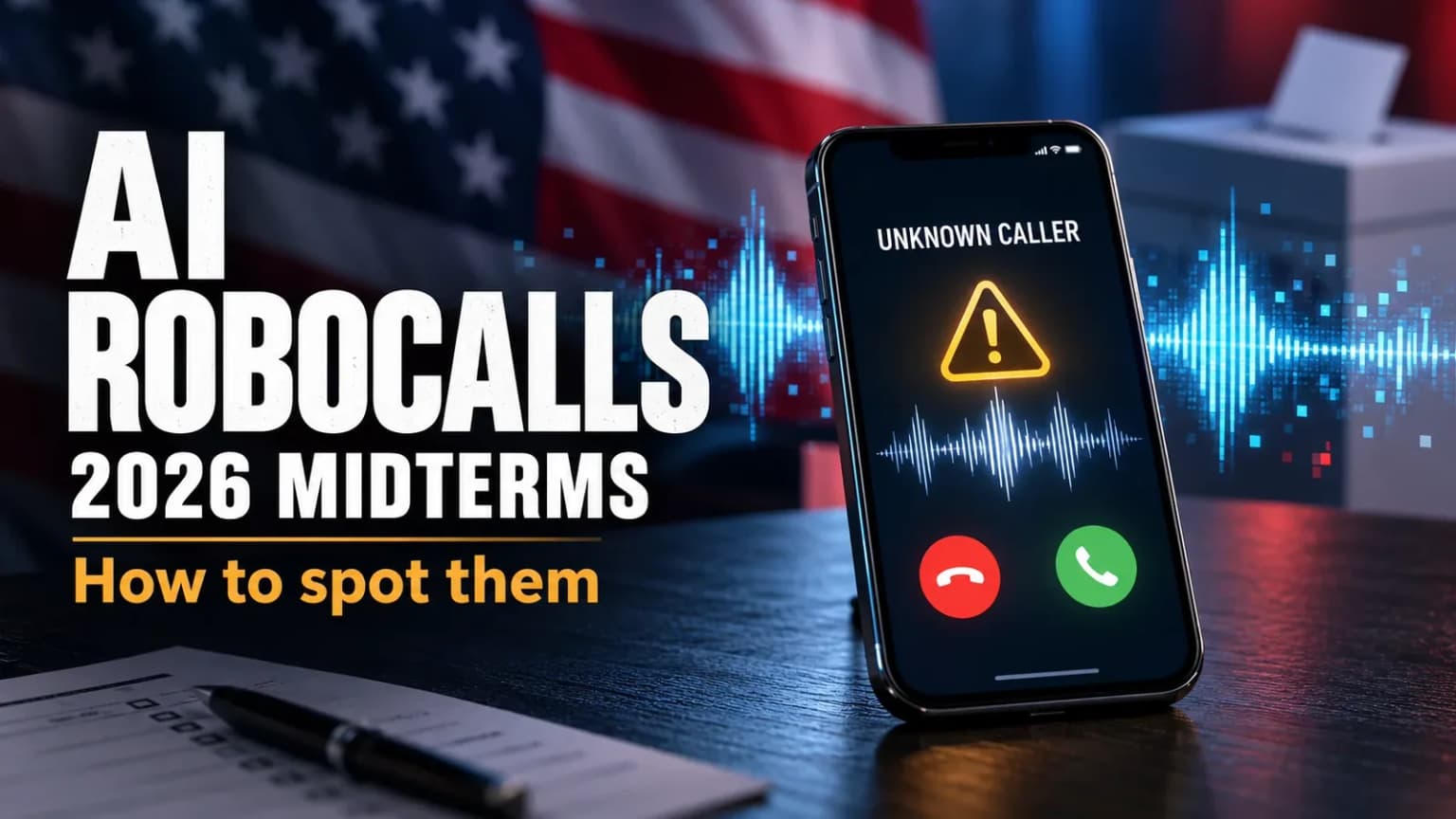
With the midterms on November 3, your phone is about to get busy. Some of those calls will be legitimate campaign outreach. Some will be AI robocalls using a synthetic or cloned voice, and a few will be designed to keep you from voting or to take your money.
The single most useful rule: no legitimate election official will ever call to tell you your polling place moved, that you must confirm registration by phone, or that you can vote over the phone. Any call doing that is false, whatever it sounds like. Hang up and check with your county election office directly.
AI robocalls matter now because the technology is cheap and convincing. A voice clone can be built from a few seconds of audio, which means a recorded call can impersonate a candidate, a party official, or someone you know. This guide covers what the law actually says, the specific signs that give an AI call away, what to do when you get one, and which pieces of common advice no longer work.
What the law actually says
There is a common misreading worth clearing up first. Headlines in 2024 said the FCC had made AI voices in robocalls illegal. The ruling is narrower than that, and knowing the difference tells you what to expect on your phone.
In February 2024 the FCC adopted a Declaratory Ruling, FCC 24-17, confirming that an AI-generated or cloned voice counts as an "artificial" voice under the Telephone Consumer Protection Act. The practical effect, as the law firm Wiley explained at the time, is that AI voice calls are not banned outright; they are subject to the same rules as any prerecorded call. Those rules require prior express consent before calling a cell phone or residential line, plus identification and opt-out obligations.
So an AI voice call to your mobile phone without your prior consent is illegal. An AI voice call to a landline you consented to may be lawful. The FCC's own guide to political robocalls sets out the landline and mobile distinctions.
What the rules require of a legitimate political call
- Identification. A prerecorded political call must state at the start who is responsible for it, and give a phone number or address during or after the message.
- Consent for mobile phones. Autodialed or prerecorded calls to cell phones need prior express consent. Live, human-dialed political calls generally do not.
- No protected lines. Prerecorded political calls may not go to emergency lines, hospital rooms, or similar protected numbers.
Enforcement is real but slow. The FCC issued a $6 million forfeiture against Steve Kramer over the AI-cloned Biden robocalls sent to New Hampshire voters in January 2024, the case that prompted the ruling. That is one penalty, years after the calls, which is why your own filtering matters more than the rulebook on Election Day.
State law may go further. Many states have passed their own rules on AI in election communications, often requiring disclosure of synthetic media. These vary widely, and federal attempts to preempt state AI laws have not displaced state election or robocall rules, per an October 2026 survey of federal AI campaign rules. Check your own secretary of state's site for what applies where you live.
How to spot an AI robocall
Voice quality alone is no longer a reliable test. Current synthesis handles breathing, hesitation and regional accents well enough that "it sounded human" proves nothing. The tells that still work are about behavior and content, not audio fidelity.
Signs in how the call behaves
- It talks over you. Many systems run a script on a timer. If you interrupt and the voice continues unaffected, it is a recording.
- It handles an off-script question badly. Ask something a script cannot anticipate: "What's the weather there?" or "What did I just say?" A recording ignores it; a basic AI agent produces a generic deflection or a noticeable pause.
- Unnatural turn-taking. A consistent half-second gap before every reply, or a reply that begins before you finish, suggests a machine managing the exchange.
- It cannot be transferred to a person. Ask to speak to a human and note whether anything happens.
- Repetition on loop. Asking it to repeat something often produces identical wording and identical intonation. A person varies.
Signs in what the call says
These matter more than the voice, because they indicate intent to deceive regardless of how the call was made.
|
Red flag |
Why it is a problem |
|---|---|
|
Tells you to vote by phone or online when your state has no such system |
Phone voting is not available to general voters anywhere in the US |
|
Says your polling place changed or your registration lapsed |
Official changes come by mail from your county, not by robocall |
|
Says you can skip voting because the outcome is decided |
A known suppression tactic, and the content of the New Hampshire case |
|
Asks for your SSN, driver's license, or bank details |
No election office needs these over the phone |
|
Asks you to "confirm" your registration by pressing a key or reading back information |
Confirms a live number and harvests data |
|
Uses a candidate's or official's voice to urge an unusual action |
The clearest sign of a cloned voice being used for deception |
|
No identification of who paid for the call |
Required for legitimate prerecorded political calls |
|
Extreme urgency before a deadline |
Pressure is designed to stop you from verifying |
Why caller ID will not help
Spoofing a local or official-looking number is trivial and widespread. A call that appears to come from your county clerk's published number may not be from them. Treat caller ID as information about nothing.
What to do when you get one
- Hang up without pressing anything. Do not press a key to opt out of a suspicious call and do not say "yes." Both confirm a working number, and a recorded "yes" can be reused.
- Write down what you can. The number shown, the date and time, what the voice claimed, and the exact instruction it gave. If your phone records voicemail, keep it. A complaint without specifics is hard to act on.
- Verify the claim independently. Look up your county election office yourself rather than calling any number the call provided. Your state's official site, reachable through vote.gov, is the right starting point.
- Report it. File with the FCC consumer complaint center under the phone category, and with your state attorney general, who has direct enforcement authority under the 2024 ruling. For content aimed at suppressing votes, also notify your secretary of state's election division.
- Warn the people it targets. Suppression calls work by reaching many people quietly. If a call targeted your precinct or your community, telling neighbors removes most of its value.
Reducing the volume beforehand
- Turn on your carrier's spam filtering (free on the major US carriers).
- Enable "Silence Unknown Callers" on iPhone or "Caller ID & spam" on Android. You will miss some real calls, so check voicemail.
- Register with the National Do Not Call Registry. Political calls are exempt, but it reduces commercial traffic so the political ones stand out.
- Do not answer unknown numbers in the final week before the election if you can avoid it. Real campaigns and real election offices leave messages.
Four pieces of advice that no longer work
Much of the robocall guidance circulating online was written for an earlier generation of technology.
"Listen for the robotic voice." Obsolete. Flatness and odd pronunciation were useful tells three years ago. Assume a convincing voice tells you nothing either way.
"Ask it to say a specific phrase." Real-time systems can generate arbitrary speech on demand. The better test is comprehension, not pronunciation: ask about something only a person present would know.
"If it's a real number, it's a real caller." Spoofing defeats this entirely. Verifying means hanging up and dialing a number you looked up yourself.
"Press 2 to be removed from the list." Legitimate for compliant campaigns, harmful for the rest, and you cannot tell which you have in advance. Hang up instead.
One mistake in the other direction
Not every recorded political call is a scam or illegal. Campaigns use prerecorded calls legally all the time, including with AI voices where consent and disclosure requirements are met. Reporting ordinary campaign outreach as fraud wastes the enforcement capacity needed for the real thing. The distinction is the content: a call that asks for your vote is campaigning, a call that tells you where, when, or whether you may vote, or asks for personal data, is the one to escalate.
Questions people ask
Are AI robocalls illegal?
An AI voice call to your cell phone or home line without your prior express consent is illegal under the TCPA, following the FCC's February 2024 ruling. AI voice calls are not banned in every circumstance; they are held to the same consent, identification and opt-out rules as other prerecorded calls.
Can I sue a robocaller myself?
The TCPA includes a private right of action, with statutory damages available per violation. That is a question for a lawyer who handles TCPA claims, not something this article can advise on for your situation.
Does the Do Not Call Registry stop political calls?
No. Political calls are exempt. Registering still cuts commercial robocalls, which makes the remaining political traffic easier to assess.
What if the call used a real candidate's voice?
That is the scenario the FCC ruling was written for. Report it to your state attorney general and the FCC, and keep the recording if you have one. Impersonating a candidate to mislead voters may also violate state election law.
Will my phone label these as spam automatically?
Sometimes. Carrier filtering catches a lot of known-bad numbers, but a fresh number running a short campaign in the final days before an election often gets through before it is flagged.
The bottom line
Before November 3, assume any call telling you something new about how or whether to vote is false until you confirm it with your county election office using a number you looked up yourself. That single habit defeats nearly every AI robocall tactic, regardless of how good the voice gets. If you receive one, report it to the FCC and your state attorney general, and tell the people around you.