
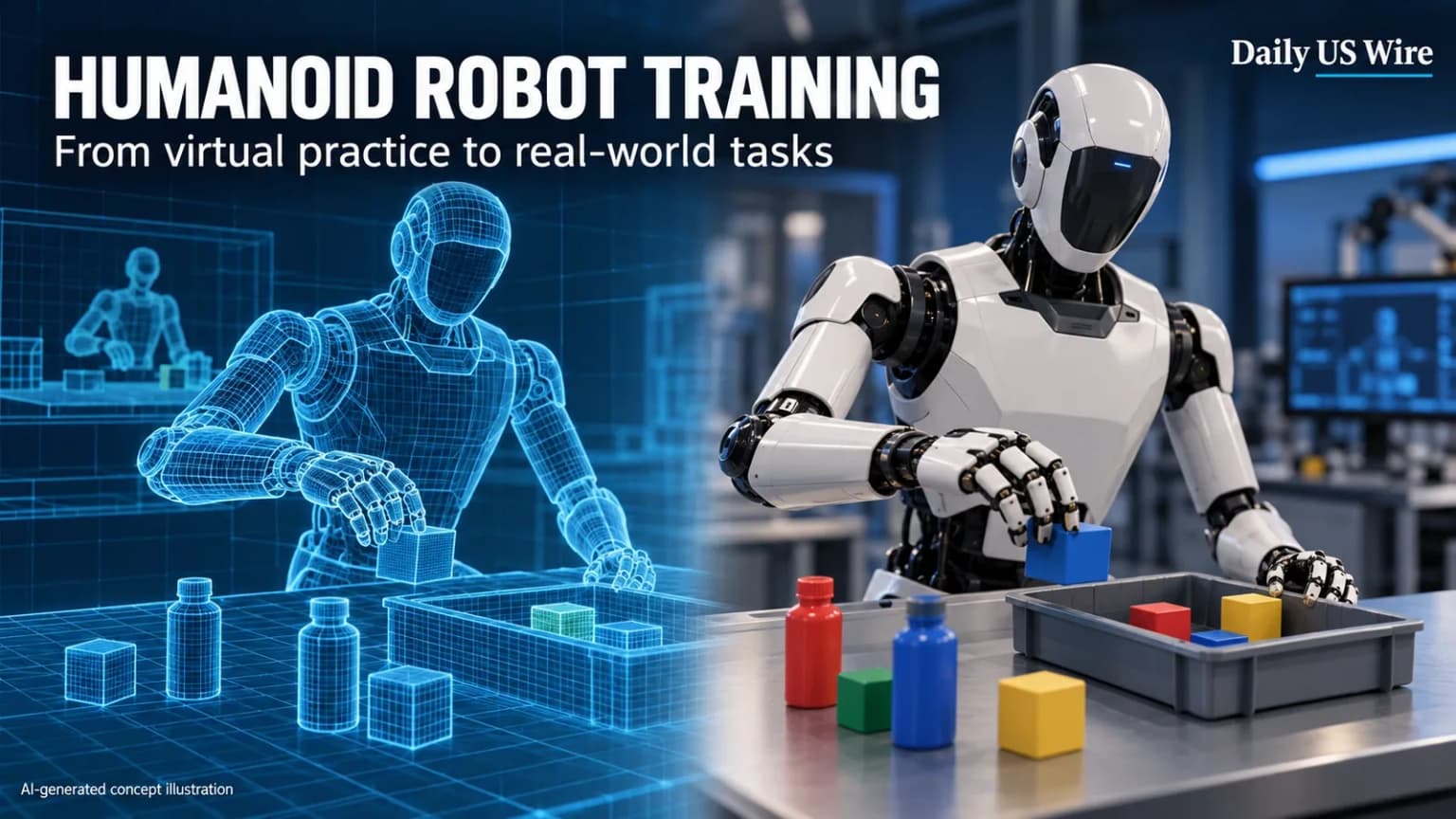
Humanoid robot training teaches machines how to turn observations and instructions into physical actions. DexForce, a robotics company based in Shenzhen, China, is pursuing that goal by generating practice data in virtual environments before transferring learned skills to real machines.
A Reuters report published October 15, 2026, described the company's approach and its claim that simulated training can reduce the expense of collecting demonstrations from people. The central question is whether those virtual lessons remain useful when objects, lighting, and working conditions change.
The opportunity is substantial, but training efficiently and working reliably are different achievements. Understanding that distinction makes the technology easier to evaluate.
What Is Humanoid Robot Training?
Humanoid robot training develops the software that guides a robot's behavior. It may involve learning from demonstrations, simulated experience, or combinations of data. The resulting control model uses information such as camera images and joint positions to select actions.
A robot does not become useful simply because it has arms and hands. It must recognize relevant objects, choose a movement, and respond to what happens next. NVIDIA's physical AI documentation describes this connection between sensing, reasoning, and acting through motors and other hardware.
Moving an empty cup, for example, is a different challenge from moving one that is slippery, partly hidden, or filled with liquid.
How DexForce Approaches Humanoid Robot Training
DexForce describes a pipeline that connects digital environments, generated data, model training, assessment, and deployment. Its DexVerse engine is designed to create simulated scenes and training examples, including variations in lighting and physical properties such as friction. These are capabilities described by the manufacturer. DexVerse documentation
The company also identifies EmbodiChain as part of its simulation and synthetic data technology, alongside a vision-language-action approach that relies mainly on generated data. A vision-language-action model connects what a robot sees and the instruction it receives with the movements it should make. DexForce technology overview
For humanoid robot training, the proposed advantage is more varied practice without physically rebuilding every scene. That does not make development free: computing, scene construction, hardware testing, and deployment still require resources.
How Virtual Practice Becomes Physical Action
A useful way to understand humanoid robot training is to follow a simplified simulation workflow. This describes the general process, not a complete specification of DexForce's proprietary implementation.
- Define the task. Specify what the robot should accomplish, such as placing a container in a tray.
- Build the environment. Represent the robot, objects, surfaces, and relevant sensor views digitally.
- Generate variation. Change object positions, lighting, or physical properties across practice scenarios.
- Train and assess. Develop a control model and test whether it completes the intended task.
- Evaluate real hardware. Measure performance on the physical robot and investigate failures.
NVIDIA documents simulation workflows that move from data collection and model development to evaluation on real equipment. The physical test remains essential because success inside a simulator does not establish performance outside it.
A Hypothetical Example: Sorting Bottles
Imagine a robot assigned to move bottles from a table into a storage bin. This is an illustrative scenario, not a reported DexForce customer deployment.
During humanoid robot training, developers could vary bottle placement, surface appearance, and camera views. The robot would encounter more than one neatly arranged starting position.
Physical testing should then include conditions withheld from practice: unfamiliar bottle shapes, distracting backgrounds, and imperfect placement. Evaluators would record completed transfers, dropped objects, and requests for assistance.
Suppose the robot succeeds with familiar bottles but repeatedly misses transparent ones. That result identifies a specific limitation. Describing the system simply as capable of sorting bottles would hide the information an operator needs.
Why the Simulation-to-Reality Gap Matters
The main challenge in humanoid robot training is that a simulated world never perfectly represents the physical one. Researchers call this difference the simulation-to-reality gap, often shortened to the sim-to-real gap.
A camera may see reflections differently. A surface may provide less grip. A motor may respond later than the simulation predicts.
One response is domain randomization: deliberately varying conditions during training. NVIDIA's documentation describes changing visual parameters, object mass, friction, and actuator behavior so the model encounters a range of possibilities. It also identifies limitations, including difficult tuning and potentially slower, more conservative movements.
Variation helps only when the training and evaluation address the conditions that matter. An attractive simulated room is not, by itself, evidence of accurate contact physics or dependable handling.
What the Research Actually Supports
A related research project, Sim2Real-VLA, includes authors affiliated with DexForce and the Chinese University of Hong Kong, Shenzhen. Its project page describes a model trained exclusively on synthetic data and evaluated on physical manipulation tasks.
The researchers separate higher-level planning from lower-level action execution. Their published examples include pouring, picking and placing, and handing over items under changed environmental conditions.
For humanoid robot training, these results support investigating whether simulated skills can transfer to physical equipment. They do not establish that a commercial robot can perform every household or workplace task.
The research team's own project description acknowledges that reliable transfer remains difficult. Task results should therefore be read alongside the tested conditions, comparison methods, and failure cases.
How to Judge a Robot Demonstration
The following checklist offers a practical way to evaluate humanoid robot training claims without relying on a highlight video.
| Ask this question | Look for this evidence |
|---|---|
| What exactly counts as success? | A completed task with clear quality requirements |
| How many attempts were tested? | Total trials, successes, and failures |
| Did anyone intervene? | Disclosed remote control, resets, and assistance |
| Were the objects unfamiliar? | Separate training and evaluation conditions |
| How long did it work? | Repeated operation beyond one selected clip |
| What happens after a mistake? | Recovery behavior and stopping conditions |
Hypothetical measurement: In a trial of 100 transfers, a robot completes 92 without help and needs intervention eight times. Report both numbers. If an operator finishes the interrupted transfers, calling the overall result a perfect success rate would obscure the supervision requirement. Also record task duration, because accuracy alone cannot show whether a system meets the pace of daily operations.
These questions are useful whether the machine is sorting inventory or handling everyday objects. Daily US Wire's laundry-folding robot explainer examines a related issue: a demonstrated capability can still require substantial help in ordinary use.
Does Synthetic Data Eliminate Human Involvement?
No. Humanoid robot training with synthetic data can reduce reliance on some manually collected examples, but people still define tasks, develop systems, evaluate results, and decide whether deployment is appropriate.
Even a model trained exclusively on simulated task data should not be described as a machine built without human expertise. The training-data source and the level of human involvement are separate questions.
For businesses, the meaningful comparison is the total effort required to achieve acceptable performance, including supervision and maintenance.
What Would Count as Meaningful Progress?
The next test for humanoid robot training is sustained usefulness: completing clearly defined jobs across changing conditions with understandable limits.
For a future deployment, ask for performance on your actual task, the frequency of human assistance, and the procedure for handling failures. Those answers will reveal more about readiness than how many virtual examples a company says it generated.