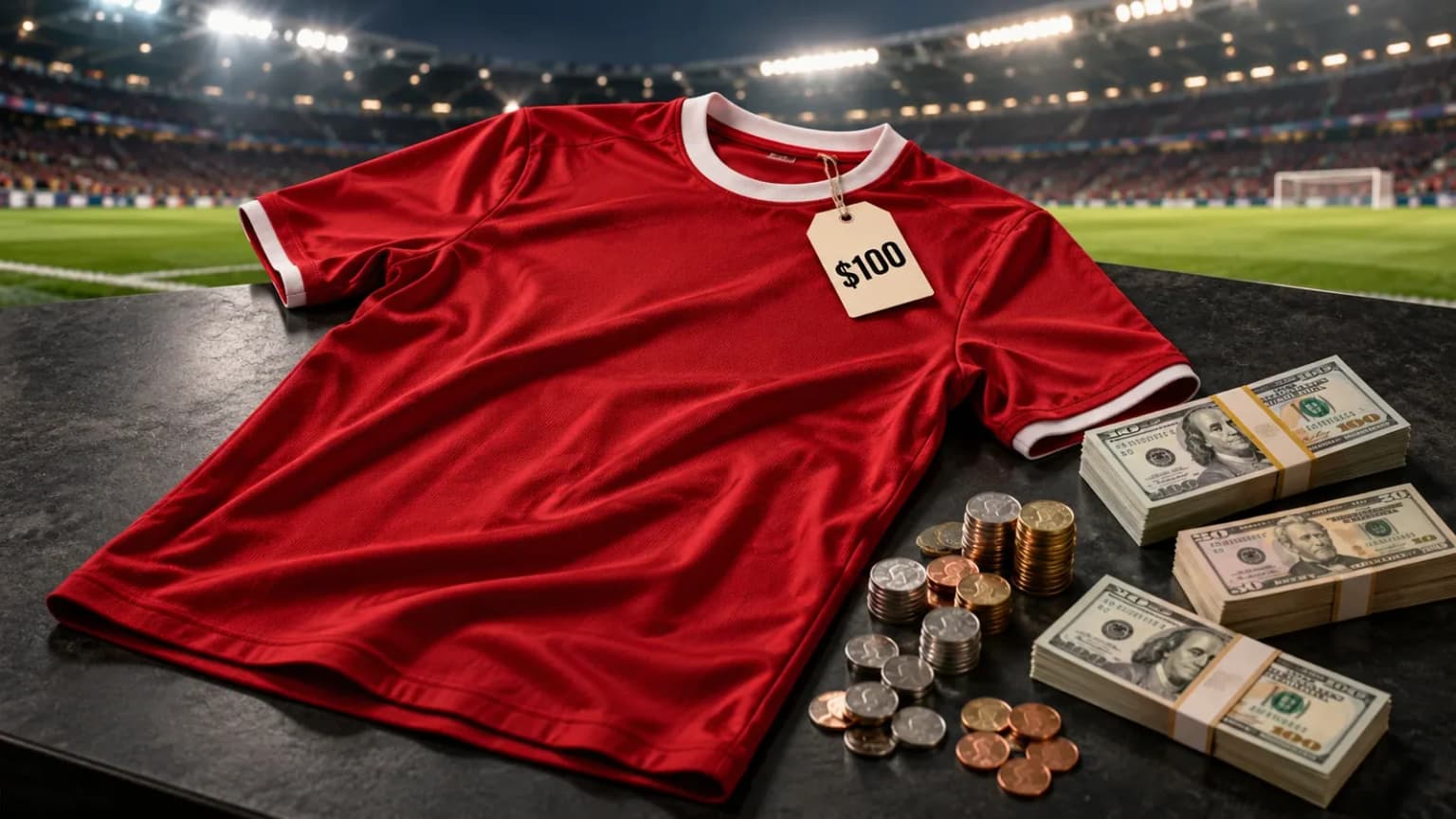
If you bought a USMNT jersey during this summer's World Cup, you paid about $100 for the Stadium version and roughly $175 for the Match version players wear on the field. The sewing labor inside that shirt likely cost a few dollars at most. That gap is the whole story of the modern football shirt, or soccer jersey as most Americans call it: a product where the person at the sewing machine earns less per hour than the retailer earns per sale.
This article explains what reporters and labor groups have actually documented inside the factories that make the official football shirt for brands like Nike and Adidas, how the retail price breaks down, and what a shopper can realistically check before buying. It sticks to published, dated findings and separates confirmed facts from estimates.
The short answer: labor is a small fraction of the price
Every independent investigation of official football shirt production in the past 15 years reaches the same conclusion. Sewing labor is typically 1 to 3 percent of the retail price, the full factory cost (fabric, trim, labor, and the factory's margin) is around 10 percent, and most of the rest goes to the brand, the federation or club that licenses its crest, and the retailer.
That means wage levels in these factories are not what drives the price of a football shirt. Doubling pay on the production line would add a dollar or two to a $100 shirt.
What the investigations found
The "£1 an hour" figure comes from a Daily Mirror investigation published on November 18, 2022. Reporters traced England's £115 World Cup shirt to the Hi-Tech Apparel factory in Bangkok, Thailand, where workers said they earned 331 to 353 baht a day, about £7.80 to £8.30, which was Thailand's minimum wage at the time. Over a standard shift, that works out to roughly £1 (about $1.20 then) an hour. Industry experts told the paper a shirt of that type costs £11 to £12 to make at the factory. Nike responded that it is committed to ethical and responsible manufacturing. (Source: Business & Human Rights Resource Centre, reproducing the Mirror report)
It was not the first such finding, and England is not the only team involved. The table below summarizes the main published investigations into football shirt and sportswear factories.
|
Year |
Who reported |
What was being made |
Where |
Reported pay |
Retail price |
|---|---|---|---|---|---|
|
2018 |
The Daily Telegraph |
England World Cup kit (Nike) |
Savar, Bangladesh |
As little as 21p an hour; 60-hour weeks |
£160 for the kit |
|
2018 |
Clean Clothes Campaign, "Foul Play" report |
Nike and Adidas sportswear |
Indonesia |
€82 to €200 a month vs. a €363 living-wage estimate |
Varies |
|
2022 |
Daily Mirror |
England World Cup shirt (Nike) |
Bangkok, Thailand |
About £1 an hour |
£115 |
|
2022 |
The New York Times |
Adidas soccer boots |
Yangon, Myanmar |
About $2.27 a day |
Varies |
The 2018 Telegraph findings were reported as claims; the English Football Association said at the time it had received assurances that England products were made in accordance with the law. (Source: Daily Mirror coverage of the Telegraph investigation, June 2018)
The Clean Clothes Campaign report, published for the 2018 World Cup, made a comparison that still frames the debate: Nike and Adidas had doubled their sponsorship budgets in a decade, while the share of a shoe's production cost reaching workers had fallen about 30 percent since the early 1990s. An Indonesian union leader quoted in the report put the labor cost of a t-shirt at barely 1 percent of its price. (Source: Clean Clothes Campaign, June 2018)
The New York Times report on Myanmar, summarized by The Business of Fashion, drew a response from Adidas that its supply-chain workers are usually paid well above local minimum wage. (Source: The Business of Fashion, 2022)
American fans are not bystanders here. A National Labor Committee report on Reebok-era NFL jerseys alleged that workers at the Chi Fung factory in El Salvador were paid about 10 cents for each $80 jersey they sewed, with mandatory unpaid overtime. The economics of a licensed NFL jersey and a licensed football shirt are the same.
Where the money goes: a worked example
The Mirror's reporting included a cost breakdown from garment industry experts for the £115 England shirt. Applied to a $100 US Stadium football shirt, it looks like this. This is a hypothetical illustration built from the 2022 UK figures, not a reported breakdown of any 2026 shirt. US import duties, retail margins, and exchange rates differ, and the US tariff picture has shifted since 2025.
|
Cost stage |
Mirror's 2022 figure (£115 shirt) |
Scaled to a $100 shirt |
|---|---|---|
|
Fabric |
£7.30 |
About $6 |
|
Cut, make, and trim (sewing labor) |
About £3 |
About $3 |
|
Factory profit |
About £1.50 |
About $1 |
|
Shipping and import duty |
About £4.50 combined |
Varies by country |
|
Landed cost at the warehouse |
About £16 |
Roughly $12 to $15 |
|
Brand, federation, and retailer |
About £80 |
The large majority |
The sewing line that produces the official football shirt is the cheapest part of the chain. Everything that makes the price feel high happens after the shirt leaves the factory: licensing fees to the federation, the brand's marketing and sponsorship spending, and the retailer's margin.
Minimum wage is not the same as a living wage
The workers sewing the England football shirt in the 2022 investigation were paid the legal minimum. That is the key detail. Brands can truthfully say their suppliers comply with local law while labor groups can truthfully say those wages do not cover basic needs. Both statements can be accurate at once.
A living wage is the amount a worker needs for food, housing, healthcare, and modest savings for a family. The Asia Floor Wage Alliance calculated it at €363 a month for Indonesia in 2018, against actual garment wages of €82 to €200. (Source: Clean Clothes Campaign)
Thailand's minimum wage has risen since 2022. Bangkok's rate has been 400 baht a day since July 1, 2025, with other provinces between 337 and 400 baht. At current exchange rates that is roughly $12 a day, or about $1.50 an hour over an eight-hour shift. The hourly figure in the headline has moved, but not by much.
How to check the football shirt you are buying: a five-step checklist
- Read the label. The country of manufacture is printed inside every official football shirt. It tells you where to look, not how workers were treated.
- Look up the factory. Nike and Adidas both publish lists of their contract factories. Match the country on your label to the brand's list to see which facilities could have made your football shirt.
- Search the factory name. The Worker Rights Consortium and the Business & Human Rights Resource Centre keep public records of wage disputes and brand responses by factory.
- Distinguish compliance from fairness. A statement that products are "made in accordance with the law" means legal minimum wage, not a living wage. Treat the two claims differently.
- Do not assume price signals ethics. The $175 Match jersey and the $100 Stadium jersey come from the same supply chain. The premium pays for lighter fabric and tighter fit, not higher wages.
Common mistakes fans make
Buying counterfeits as a protest.
Fake jerseys come from factories with no brand oversight, no published supplier list, and no public wage records. If the concern is working conditions, a counterfeit football shirt is the least transparent option on the market.
Assuming a boycott helps workers.
The unions quoted in these investigations consistently ask for higher wages and the right to organize, not for orders to disappear. When orders fall, factories close and workers lose their jobs; the 2020 pandemic layoffs are the clearest recent example.
Treating 2022 numbers as current.
The £1-an-hour figure is from a specific factory in a specific year. Minimum wages in Thailand, Bangladesh, and Cambodia have all changed since. Use it as a benchmark for what a football shirt factory pays, not a live quote.
Blaming the factory.
Suppliers in these reports earned about £1.50 per shirt. The parties with room to raise wages are the brands and federations that set prices and licensing fees.
What is confirmed and what is not
Confirmed: Multiple independent investigations between 2018 and 2022 found workers making licensed national-team gear for Nike and Adidas earning at or near local minimum wages that labor groups classify as poverty wages. Brands responded by citing legal compliance or pay above local minimums.
Not confirmed: As of October 2026, no comparable published investigation has examined the factories that produced the 2026 World Cup shirts specifically. Whether conditions improved, stayed the same, or worsened at those facilities is not documented in public reporting.
For the business side of why Nike's pricing power has come under pressure, see our earlier report on why Nike is struggling.
The takeaway
The price of an official football shirt has almost nothing to do with the pay of the person who sewed it. If you want your purchase to matter, the most useful step is not to stop buying but to make the supply chain visible: read the label, check the brand's factory list, and support the organizations that track and publish what those factories pay. Pressure that reaches the brand and the federation is the only pressure that changes the number on the production line.