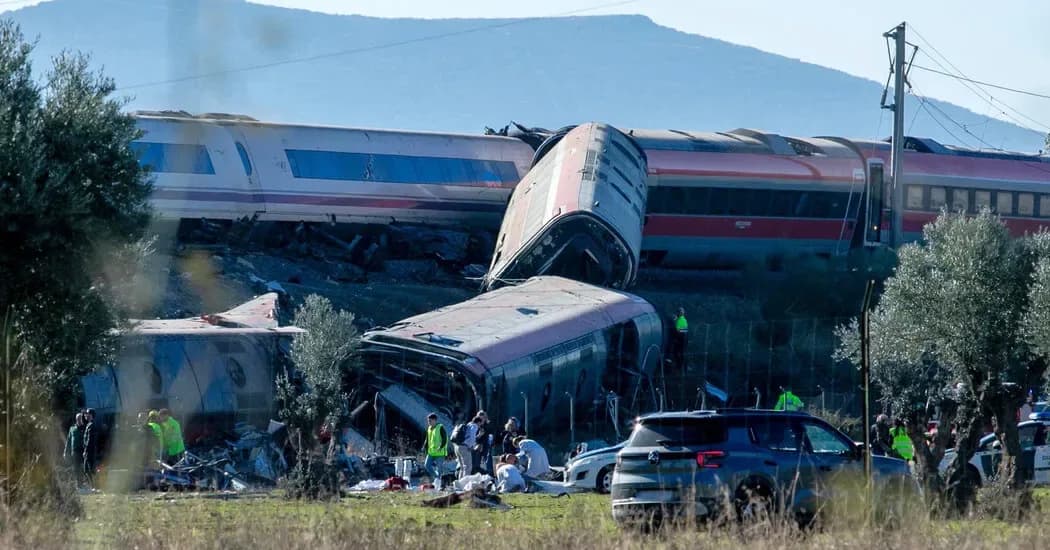
A Spain train crash on Wednesday morning, Oct. 28, 2026, has killed at least 30 people, according to the regional government of Castilla-La Mancha, which described that number as a minimum. A high-speed train struck the back of another on the Madrid–Seville line near the town of Urda, in Toledo province. The cause has not been officially identified, and high-speed service between Madrid and southern Spain is suspended.
This is the second deadly collision on the same corridor, involving trains from the same two operators, in just over nine months. Below is what has been confirmed, what remains unverified, how a rear-end collision can happen on a line designed to prevent one, and what Americans traveling in Spain should do now.
What Happened in the Spain Train Crash Near Urda
Castilla-La Mancha's 112 emergency service said the collision happened at about 8:54 a.m. local time near Urda station, roughly 75 miles south of Madrid by rail. Spain's rail infrastructure manager, ADIF, placed it between Mora, Orgaz and Urda, with both trains running the Madrid–Seville route.
Two operators were involved: state-owned Renfe, running one of its AVE high-speed trains, and Iryo, a private competitor. Spain's Transport Ministry said that, based on initial indications, the Renfe train struck the rear of the Iryo train, knocking two Iryo cars off the track and down an embankment.
Both trains were heavily booked. Regional government spokesperson Esther Padilla said 397 passengers were on the Renfe train and 147 on the Iryo train. Urda's mayor, Manuel Galán, told state broadcaster TVE that emergency officials asked the town to prepare a sports hall to receive passengers.
One passenger in the last car of the rear train told Catalunya Ràdio he felt a "giant blow" about 45 minutes into the trip, then saw a wrecked Iryo train beside the track.
Why the Spain Train Crash Death Toll Keeps Changing
Early Wednesday, Padilla said at least 10 people had died and warned the number could rise. By late morning, the regional government put the toll at a minimum of 30.
Some Spanish outlets are reporting higher numbers. El Español, citing police and civil protection sources, reported at least 50 deaths, while other outlets stressed that estimates in that range were not yet official.
That gap is common in the first hours of a mass-casualty event. Rescue crews are still reaching damaged cars, and officials usually confirm deaths only after recovery and identification. Until the regional or national government updates its count, treat higher figures in Spain train crash coverage as unconfirmed. The number of injured has not yet been officially released.
What Is Confirmed and What Is Still Unclear
Officials have confirmed the basic facts of the Spain train crash: the location near Urda, the two operators, the rear-end impact, the derailment of two Iryo cars, a death toll of at least 30, and the suspension of high-speed service between Madrid and Andalusia.
Several key questions remain open, including the final number of dead and injured, how long the line will stay closed and, above all, what caused the Spain train crash. ADIF sources said the cause has not yet been identified. El País, citing government sources, reported that investigators are examining a failure in the main signaling system that forced about eight trains to stop in the area, along with a possible erroneous order from the control center. Those are lines of inquiry, not findings.
How Could One Train Hit Another on a Protected Line?
To understand why engineers call this Spain train crash so unusual, it helps to know how Spain's oldest high-speed line is protected.
The Madrid–Seville line uses LZB, a German-designed automatic train control system. In plain terms, it keeps a continuous data link between the track and the train, tells the driver the safe speed and stopping point, and brakes the train automatically if the driver does not. José María Goicolea, a board member of Spain's civil engineers' association, told Spanish media that the system stops a train on its own when it detects another train or obstacle ahead, which should make a same-track, same-direction collision impossible.
Goicolea's working theory, which he stressed was speculation, is that LZB was not functioning and trains were running under ASFA, an older backup system that protects trains at specific signals rather than continuously, with drivers operating more manually. José Trigueros, president of the same association, also pointed to an LZB failure early that morning.
If the primary system was down, the Spain train crash investigation will likely focus on how trains were authorized to move under degraded conditions, who gave those instructions, and whether backup rules were followed. Forecasters have ruled out weather as a factor.
A Painful Year for Spanish Rail
The Spain train crash lands on a country still recovering from January's disaster. On Jan. 18, an Iryo train derailed near Adamuz, in Córdoba province, and was struck by an oncoming Renfe train, killing 46 people. Wednesday's collision happened on the same line, with trains from the same two operators.
Spain's independent rail accident investigators, known as CIAF, have provisionally pointed to a broken rail weld at Adamuz, though their final report is still pending. The line was closed for about a month and reopened on Feb. 17. Two days after Adamuz, a commuter train crash near Barcelona killed a trainee driver, and the drivers' union later called a strike over safety.
The early focus differs between the two cases. Adamuz centered on the track itself, while attention after this Spain train crash has turned to signaling and train control. If both are confirmed, Spain will face hard questions about maintenance and oversight across its rail network, not just one stretch of track.
What US Travelers Should Do After the Spain Train Crash
Madrid–Seville and Madrid–Córdoba–Málaga trains are a standard part of many American itineraries. If you are in Spain or traveling soon, use this checklist:
- Check your train status with the operator. Renfe suspended service between Madrid, Ciudad Real and Andalusia and said affected passengers can change or cancel tickets free of charge. If you booked with Iryo or Ouigo, check that company's app or website for its policy.
- Line up a backup. Domestic flights between Madrid and Seville or Málaga, along with intercity buses, are the usual alternatives. Expect higher prices and full seats while the line is closed.
- Let family know you're safe. If you were anywhere near the route Wednesday morning, a quick message prevents unnecessary worry.
- Enroll in STEP. The State Department's Smart Traveler Enrollment Program sends alerts and helps the embassy reach you in an emergency. The US Embassy in Madrid can be reached at +34 91-587-2200.
- Review your travel insurance. Look for trip interruption coverage and whether common-carrier disruptions are included, and save receipts for any added costs.
For context, the State Department's advisory for Spain has remained at Level 2, Exercise Increased Caution, since an Aug. 1 update, citing terrorism and unrest rather than rail safety. For more on handling European travel disruptions, see our guide to the Lufthansa Frankfurt fuel shortage.
What Happens Next
The response is shifting from rescue to investigation. A Civil Guard major-disaster forensic team was sent to the site, and Renfe said it activated its assistance plan for victims and families. Prime Minister Pedro Sánchez expressed solidarity with the victims' families.
In the coming days, watch for an official death and injury count, a preliminary statement from CIAF on the train-control systems, and a timeline for reopening the line. Data recorders from both trains and control-center logs should answer the central question of the Spain train crash: how one train reached the back of another on the same track.
The takeaway: The confirmed facts are grim but limited. A Renfe train struck an Iryo train near Urda, at least 30 people died, and the cause of the Spain train crash is still under investigation. If your plans run through southern Spain, contact your rail operator today and rely on official updates over early estimates.